Disclosure: we make ThumbnailPeak, which sells tools for making and testing thumbnails. That's a reason to be careful with this topic, so every claim below is either YouTube's own or something we measured, and we've included what we found that doesn't flatter thumbnails.
On YouTube, most viewers decide whether to watch a video from two things: its thumbnail and its title. YouTube even measures how often that decision goes your way, as the impressions click-through rate: how often people watched after seeing your thumbnail.
So thumbnails matter. The more useful question is how much, and for what. Here's what we found:
- Almost every successful video uses a chosen thumbnail. Of 7,052 recent videos we checked, 98% didn't use any of the three frames YouTube saves from the video. YouTube says 90% of its best-performing videos have custom thumbnails.
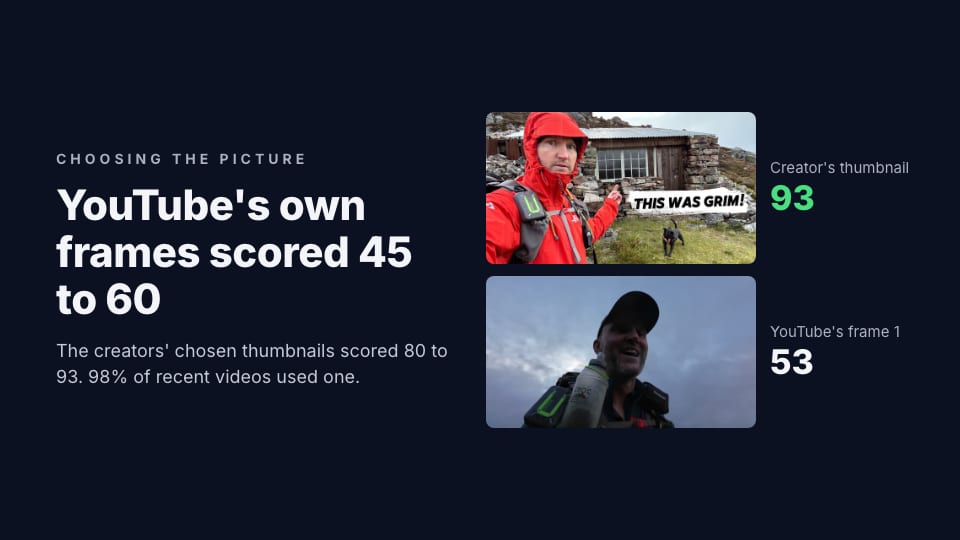
- A chosen thumbnail is worth a lot. We critiqued YouTube's three saved frames from three videos. They scored 45 to 60; the creators' own thumbnails scored 80 to 93.
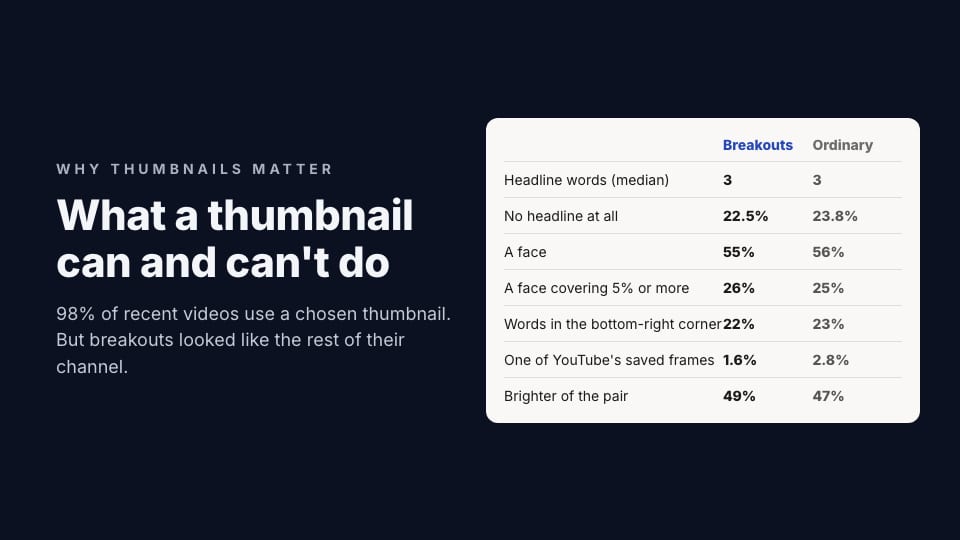
- But breakouts looked like the rest of their channel. We compared 3,523 breakouts with four ordinary videos each from the same channels. Same number of words, same faces, same colours, the same overall look. Nothing we measured set the breakout apart.
- So a thumbnail sells the idea, it doesn't replace it. The videos that took off were different ideas in the channel's usual packaging.
What a thumbnail does
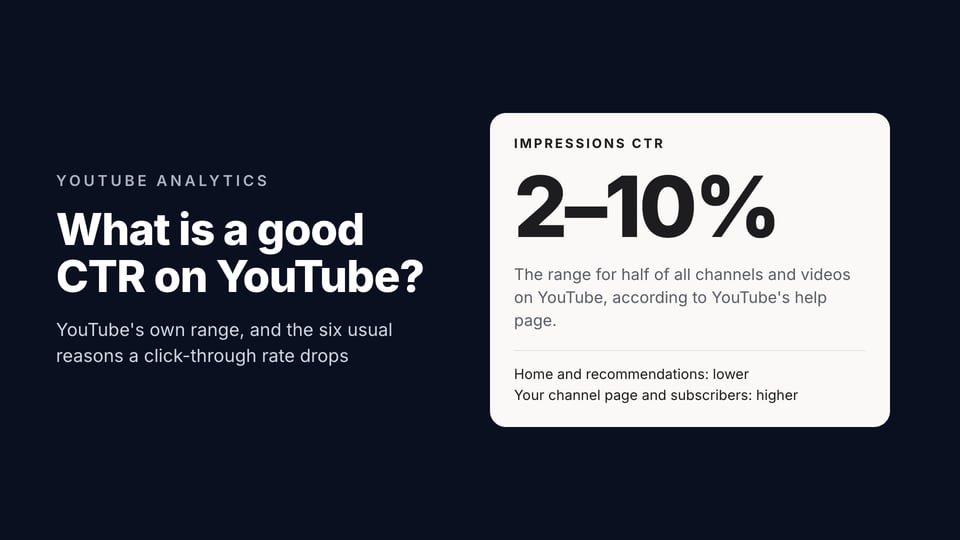
When YouTube shows your video on someone's Home page, in search or beside another video, that's an impression. If they watch, it counts towards your click-through rate. YouTube says half of all channels and videos have a CTR between 2% and 10%, so most impressions don't become views either way.
Your thumbnail is the biggest thing in that impression. On a phone, it fills the width of the screen; the title sits under it in small type. In the second a viewer gives it, the thumbnail has to say what the video is and why it's worth watching.
YouTube treats it as important enough to test. Its own A/B test, Test & Compare, shows up to three thumbnails on the same video and keeps the one that earns the most watch time. Nothing else changes: same video, same title. If the thumbnail didn't matter, there'd be nothing to test.
Almost every successful video has a chosen thumbnail
YouTube saves three still frames from every video. If you don't upload a thumbnail, you get a frame like these.
Almost nobody does. From ThumbnailPeak's Breakouts sample on 22 October 2026, we took 3,525 recent breakouts, videos that got at least three times their channel's usual views, and one ordinary video from each of the same channels. Only 1.6% of the breakouts and 2.8% of the ordinary videos used one of YouTube's frames as their thumbnail. YouTube's own thumbnail tips put it this way: "90% of the best-performing videos have custom thumbnails."
What a chosen thumbnail is worth
To see the difference, we ran YouTube's three frames from three videos through ThumbnailPeak's AI critique, each against the video's real title, and then the creator's own thumbnail.
The frames scored 45 to 60. The creators' thumbnails scored 80 to 93. The frames weren't blurry or badly lit. They just showed an ordinary second from the middle of the video: the creator walking, a kitchen before the bread was made. None showed what the title promised. We go through all nine in how to choose the picture for a thumbnail.
That's the floor a chosen thumbnail lifts you off. A picture that shows the video's subject, at its best moment, is the minimum.
What a thumbnail can't do
Here's the part thumbnail advice usually skips. If thumbnail design made videos break out, a channel's breakout should look different from its ordinary videos: fewer words, a bigger face, brighter colours. We checked that across 3,523 channels, comparing each breakout with four of the same channel's ordinary recent videos.
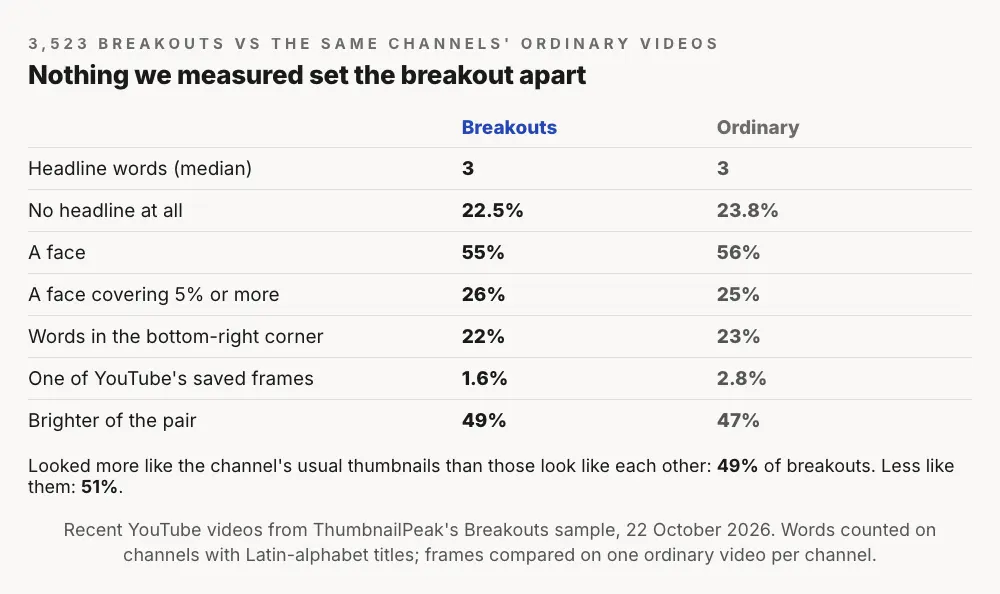
They didn't look different. The breakouts had the same number of headline words as their channel's ordinary videos, the same share of faces, the same brightness and colour, and the same overall look. Compared one pair at a time, every measure came out close to a coin toss. The only differences were small ones: breakouts had slightly more detail, not less, and their biggest line of words was slightly more often the larger of the pair.
A larger sample from November, compared the same way, found a small lean in the overall look: 58% of 3,410 breakouts sat further from their channel's other thumbnails than a typical ordinary video did. Where a breakout did stand out, it was showing something new, and its title often changed with it: our study of 3,410 breakouts' titles and thumbnails has the numbers.
That doesn't mean their thumbnails didn't matter. It means the measurable design (how many words, whether there's a face, what colours) was the channel's habit, and the habit stayed the same. What changed was what the thumbnail showed and promised.
Two channels show it clearly:
- Walk With Wallace, a hiking channel, uses the same look on every thumbnail: his face, a stone hut or a tent, a few words on a torn paper label. His recent videos usually get around 6,000 views. His biggest, a night in a mountain hut that went wrong, has more than 600,000. Its thumbnail looks just like the others. Our branding guide has the details.
- Outer Range, an exploration channel, used one "caught it on camera" design on four videos. They got 203,000, 675,000, 1.13 million and 1.57 million views. Same design, a sevenfold range. What it showed, a cave, an island or a glacier, made the difference. Our guide to thumbnail templates has all 21 of its recent videos.
A thumbnail can only sell the idea that's in the video. A strong idea in a weak thumbnail gets passed over. A weak idea in a strong thumbnail gets clicked, and then left, which is why misleading thumbnails backfire: we tested where that line is in our post on clickbait thumbnails.
Where to spend your time
- The idea and the title first. They decide what the thumbnail can promise. If you can't say in one sentence why someone would click, no design will fix it.
- A picture that shows what the title promises. Not a frame from the middle of the video. A posed photo or a chosen frame of the subject at its best moment.
- One thing the eye lands on first, and a few big words. Our guides cover composition, how many words, fonts and colour.
- Your channel's look, kept. Breakouts kept it, and your subscribers use it to spot your videos.
- A check before you upload. ThumbnailPeak's free thumbnail tester shows your thumbnail in a real YouTube feed, and the critique checks it against your title.
- A test after you upload. If your channel has Test & Compare, test two or three really different thumbnails and let watch time decide.
Our step-by-step guide to making a thumbnail puts all of that in order.
Frequently asked questions
Do thumbnails really matter on YouTube?
Yes. They're most of what a viewer sees before deciding to watch, and almost every successful video uses a chosen one: 98% of the 7,052 we checked. But a thumbnail sells the video's idea. It can't make a weak idea break out.
Does the thumbnail affect the YouTube algorithm?
Indirectly. YouTube recommends videos based on how viewers respond: what they watch, like and say in satisfaction surveys. A thumbnail changes how many viewers click, and a misleading one changes how satisfied they are when they do.
Can a better thumbnail save a video?
It can help a good video that was being passed over, which is what YouTube's Test & Compare is for. It can't rescue a video whose idea doesn't interest anyone, and a thumbnail that overpromises usually loses viewers once they click.
Should I use YouTube's automatic thumbnail?
Only as a last resort. In our test, YouTube's saved frames scored 45 to 60 against 80 to 93 for the creators' own thumbnails, and only 1.6% of recent breakouts used one.
How we did it: the videos come from ThumbnailPeak's Breakouts sample on 22 October 2026. For each of 3,523 channels with a video published 2 to 20 October at three times or more its usual views, we took that breakout and four recent ordinary uploads (0.5 to 1.5 times its usual views), and measured words, faces and colours with Apple's Vision framework and standard image statistics on our own computer, as described in our posts on text, faces and colour. Headline words were counted only on channels with Latin-alphabet titles (3,241). For YouTube's saved frames, we compared 3,525 breakouts and one ordinary video from each of the same channels with the three frames YouTube stores for each video. The critiqued videos are published under CC BY 3.0 by Walk With Wallace, Skip The Junk and Scott and Liza Redefined, and each frame and thumbnail was critiqued once with its video's title on 22 October 2026. View counts are YouTube's on 22 October 2026.