Disclosure: we make ThumbnailPeak, and these videos come from its free Breakouts tool. The titles belong to their creators, who had nothing to do with this post, and are shown here for commentary. Every title below was read on 7 November 2026.
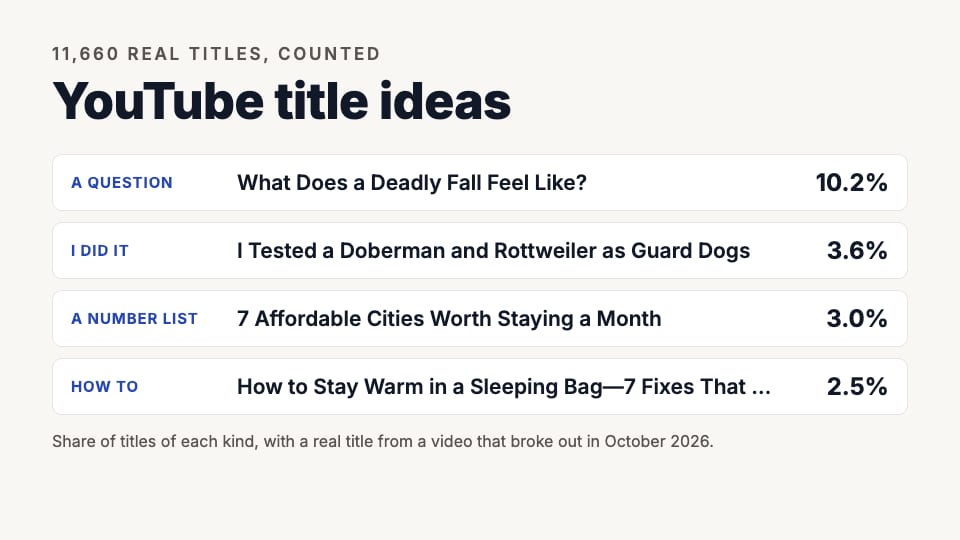
The YouTube title ideas that real videos use most are simple: a title in two parts split by "|", ":" or "-" (38% of titles), a word in capital letters (34%), an exclamation mark (20%), "I" or "my" (17%) and a question mark (10%). We counted 24 kinds of title on 11,660 real YouTube titles, and the templates that lists of title ideas give were rare: "how to" was in 2.5% of titles, and 3.0% opened with a number. Below is every kind, each with a real title as an example. We can't tell you which title gets more clicks, because YouTube shows click numbers only to the channel's owner. What we can count is what real titles look like. Here's what we found:
- The classic templates are rare. "How to" was in 2.5% of titles. A title that opens with a number ("7 Things…") was 3.0%, and "vs" was 2.3%.
- What is common is how a title is written: its punctuation and its layout. 38% of titles had two parts split by "|", ":" or "-". 34% had a word in capital letters, and 20% had an exclamation mark.
- The numbers change with the YouTube category. "How to" was in 9.4% of titles in Howto & Style and 0.2% in Travel & Events. "I" or "my" was in 27% of Gaming titles and 7.7% of Film & Animation titles.
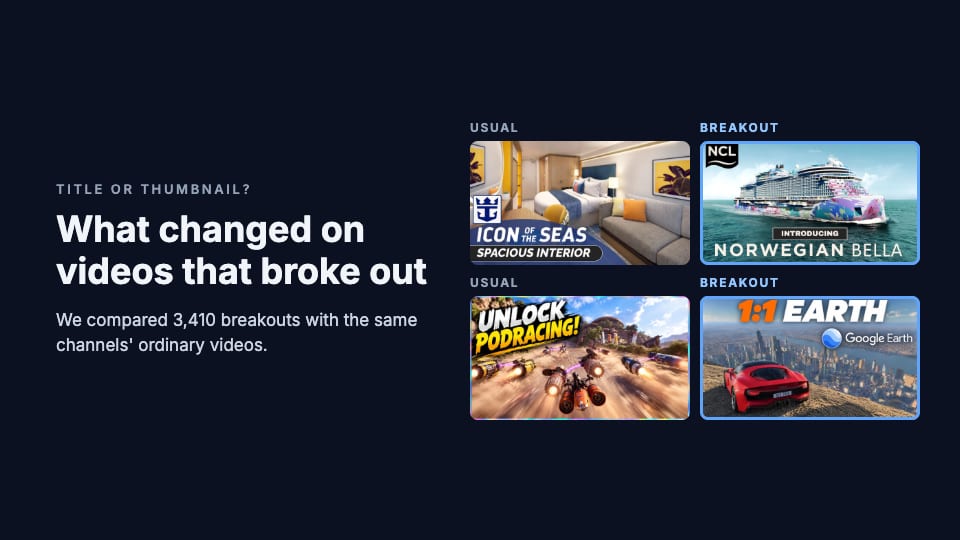
- Hit videos used almost the same kinds of title. We call a video a breakout when it got at least three times its channel's usual views. For every kind of title, breakouts and the same channels' ordinary videos were less than 3 percentage points apart.
Need a title today? The steps under "How to write a good title for your YouTube video" are near the end of this post.
How we counted
Every week, ThumbnailPeak's Breakouts tool looks through YouTube for videos that got far more views than their channel usually gets. We call such a video a breakout. We took 2,332 channels that write their titles in English, and five videos from each. One was the channel's best breakout published in October 2026, a video that got at least three times the channel's usual views. The other four were its newest ordinary videos, which got 0.5 to 1.5 times the channel's usual views. That gave 11,660 titles.
Then a computer program checked every title for 24 kinds of title. Each kind has a fixed rule that looks for certain words or marks. A question is a title with a question mark. "How to" is a title with those two words. A title can be of several kinds at once.
This count has two limits. First, a rule finds words and cannot understand meaning. So we could not count "curiosity" or "emotional" titles, which some lists of title ideas include. Second, we counted English titles only.
24 YouTube title ideas, with real examples
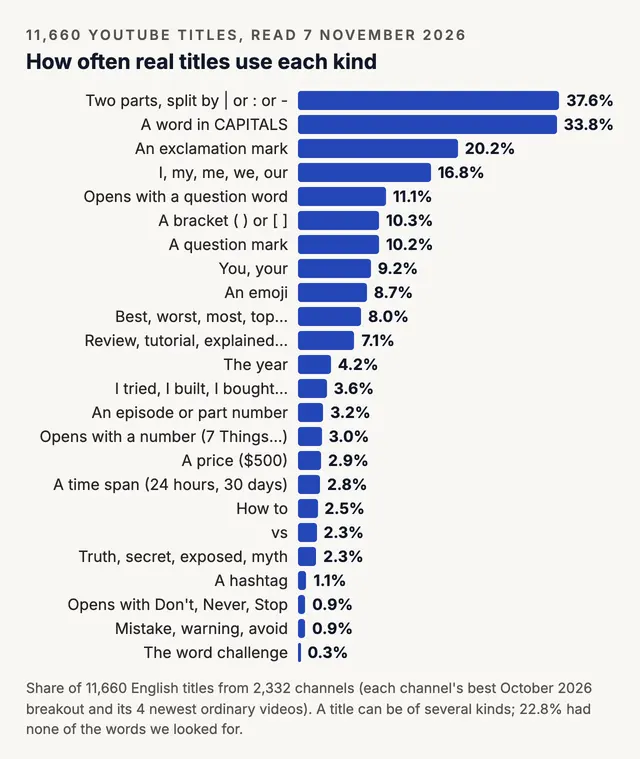
The three longest bars are about how a title is written, not which template it uses: two parts, a word in capitals, an exclamation mark. The chart gives the order from most to least common. Below, we sort the 24 kinds into five groups. Every example is a real title from a breakout.
How the title is written. These kinds are about punctuation and layout, not about words. They were the most common kinds by far.
- Two parts (38%). The title has two parts with "|", ":" or "-" between them. One part gives the reason to watch. The other names the topic, the series or the channel, and either can come first. "Tiger vs Brown Bear: What Actually Happens in the Wild" (Zooologist).
- A word in capitals (34%). In 75% of these titles it was one or two words, not the whole title. The count includes abbreviations such as DIY. "I Survived Alone in an INFECTED Military Facility..." (Wakeyyx).
- An exclamation mark (20%). "I Built a DIY Bench Power Supply from an Old ATX PSU!" (DIY-ary).
- A bracket (10%). The bracket holds a detail that would make the main part too long. "The Truth About 0W-20 vs 5W-30 Oil (All Chevy Engines Tested)" (Chevy Central).
- An emoji (8.7%). "Unboxing the Ducati Panigale V4 MM93 🔥 Only 293 Worldwide!" (Moto Therapy With Aussie Kawiman).
- A hashtag (1.1%). "I Created the Ultimate Sealing Method & My Hair Changed in 30 Days! #KIMGLOW" (Kimberly Cherrell).
Who is speaking.
- I, my, me, we, our (17%). The creator speaks as a person in the story. "I've Seen a Lot of Trains, But I've Never Seen This..." (Midwest Railroads). In the rest of this post, "I" or "my" is short for these five words.
- "I" with an action (3.6%): I tried, I built, I bought, I tested. "I Tested a Doberman and Rottweiler as Guard Dogs" (The Dog Brain). Our rule knows 27 verbs, so the true share is a little higher.
- You, your (9.2%). The title talks to the viewer. "What Happens to a Spider After You Vacuum It Up?" (Zyka).
Questions.
- A question mark (10%). "What Does a Deadly Fall Feel Like?" (Whixr). "How Did Humans Actually Invent the Toilet?" (Historae). "How Fast Is a 340 Dart Swinger?" (Ransky Racing).
- Opens with a question word (11%): How, Why, What, Is, Can and similar words. More than half of these titles (56% of 1,297) had no question mark. They were statements, not questions. One example is "Why Living Under a Dome on Mars Would Kill You" (Cosmic Sketchlab). A title like this promises the answer and does not ask.
The classic templates. Lists of title ideas give these templates. On real titles each of them was rare. That does not make them wrong: it means most real titles are not built on a template. "How to" was still in 9.4% of Howto & Style titles.
- Best, worst, most, top (8.0%). "Western Massachusetts: The Most Misunderstood Place in America" (WunderLust Labs).
- Opens with a number (3.0%). "7 Things Japanese Pilots Found Strange About the F4U Corsair" (Frontline WW2 Tales). "7 Affordable Cities Worth Staying a Month" (Good Life Road). Our rule misses a list whose number comes later ("The 7 Most…"), so the true share is a little higher.
- How to (2.5%). "How to Crochet a Maple Leaf 🍁 | Easy Fall Crochet Tutorial for Beginners" (Crochet By Gillian). "How to Stay Warm in a Sleeping Bag—7 Fixes That Work!" (Matt Kessler - Revelo).
- vs (2.3%). These titles compare two things. In Sports, they name the two sides of a match. "EV vs DIESEL: We Drove 111 Miles… The Cost Difference Surprised Us!" (Whatta Dadventures).
- Truth, secret, exposed, myth (2.3%). "Christine Was a Lie — The Truth About Stephen King's Killer Car" (This Old Car).
- Opens with Don't, Never or Stop (0.9%). "Don't Buy a PS5 Pro Until You See This Comparison" (Euphreme).
- Mistake, warning, avoid (0.9%). "7 MISTAKES That Make Your CAT Think You Don't Love Them 💔" (The Curious Cat).
- The word "challenge" (0.3%). "I Built a Fragrance Collection Using ONLY Walmart ($100 Challenge)" (Triple B).
A fact in the title.
- A word that names the type of video (7.1%): review, tutorial, explained, reaction, documentary and similar words. It tells the viewer what kind of video this is. "Every Ship That Was the Biggest in the World, Explained" (KNOT & RAIL).
- The year (4.2%). For example a car's model year, or the date of an event. "The Only iPhones Actually Worth Buying in 2026" (at home).
- An episode or part number (3.2%). "I Broke My Neck 3,000ft Up An Alaskan Mountain | Ep 4" (Reece Wallace).
- A price (2.9%). "The $1,300 Freeze Dryer: Did Harvest Right Nail It?" (The Freeze Drying Community). "How One Pilot Destroyed a $300M Cargo Plane in Seconds" (Black Box Down).
- A time span (2.8%): 24 hours, 30 days, 20 years. "3 Days Alone in the Remote Canadian Wilderness" (Matt Chung).
About 23% of titles had none of the words we looked for. These titles fit no template we could name. Two examples: "Wild Dogs Surround a Porcupine" (Wild Beginnings) and "The New Way to Make Stained Glass in Minecraft" (ThisWasAFlop).
Title ideas by category
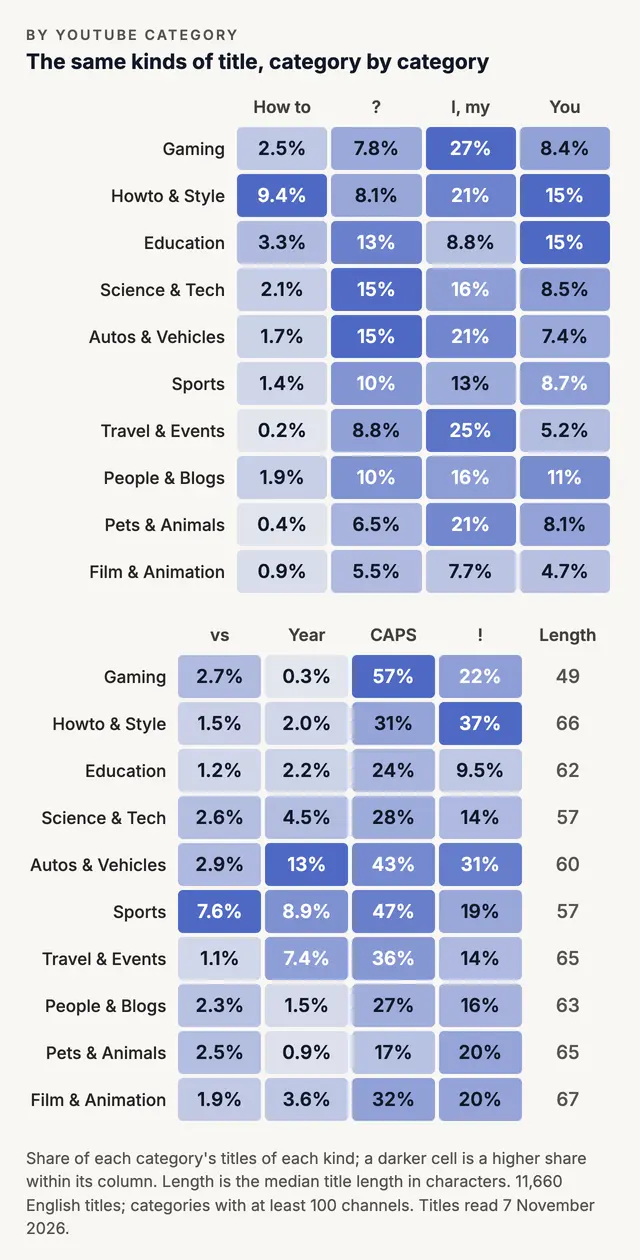
The same kind of title can be normal in one category and odd in another:
- Howto & Style uses "how to" the most: in 9.4% of its titles. Education (3.3%) and Gaming (2.5%) come next. Every other category was under 2.2%. Howto & Style also had the most exclamation marks (37%).
- Gaming titles are short and use many capitals: a median of 49 characters, and 57% had a word in capitals. 27% used "I" or "my". "I" with an action was in 8.3%, the highest of any category.
- Education and Science & Technology titles often ask. 19% of Education titles opened with a question word such as How, Why or What, and 15% of Science & Technology titles had a question mark.
- Autos & Vehicles titles often hold a fact: the year in 13% and a price in 5.5%. They also ask often: 15% had a question mark.
- Sports had "vs" in 7.6% of titles, and every other category was under 3%.
- Travel & Events used "I" or "my" in 25% of titles, and best, worst or most in 13%.
- Film & Animation titles were the longest (a median of 67 characters). 63% had two parts, and only 7.7% used "I" or "my".
So start from what viewers in your category are used to. A "how to" title is ordinary in Howto & Style and unusual in Travel & Events.
Did breakouts use different titles?
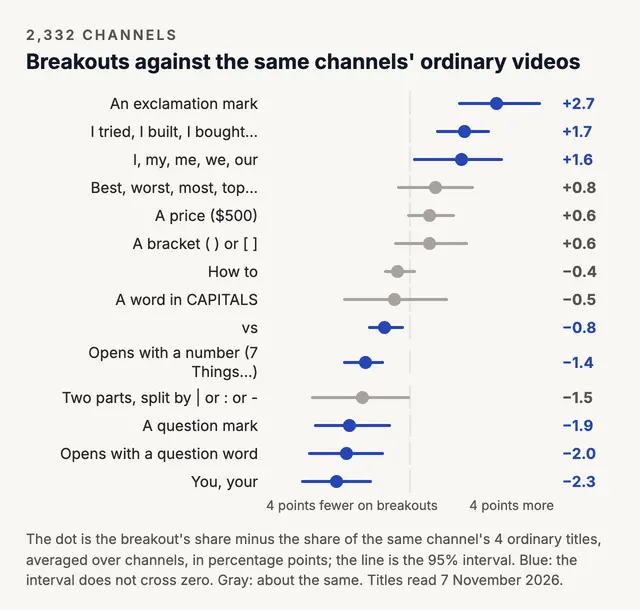
Breakouts used almost the same kinds of title. For each channel we compared its breakout's title with its four ordinary titles.
- A little more common on breakouts: an exclamation mark (22.4% of breakouts against 19.7% of ordinary titles), "I" with an action (5.0% against 3.3%), and "I" or "my" overall (1.6 percentage points more).
- A little less common on breakouts: "you" (7.4% against 9.7%), a title that opens with a question word (9.5% against 11.5%), a question mark (8.7% against 10.6%), a title that opens with a number (1.8% against 3.3%), and "vs" (1.7% against 2.5%).
- About the same: "how to", best or worst, brackets, capitals, two parts, the year, prices and the other 9 kinds.
Every difference is under 3 percentage points. These differences do not show that a kind of title made a video break out. We counted what the titles look like, not why the videos did well.
A breakout's title mostly followed what its channel usually writes. Take question marks. On the 1,681 channels where none of the four ordinary titles had a question mark, 4.8% of breakouts had one. On the 24 channels where all four ordinary titles had one, 62.5% of breakouts had one too.
The same was true for "I" or "my": 6.4% of breakouts on channels that never used it, against 77.8% on channels that always used it. For a word in capitals the numbers were 10.7% against 85.1%. Our study of titles and thumbnails on 3,410 breakouts found this for length and punctuation too. A breakout's title looks like its channel's other titles.
How long are the titles in this count?
The median title in our count was 61 characters: half were shorter and half were longer. 51% were longer than 60 characters. Gaming titles were the shortest (a median of 49) and Film & Animation the longest (67). YouTube's limit is 100 characters. Its help page says: "Video titles have a character limit of 100 characters".
Our earlier study has the full chart of how long YouTube titles are. Its numbers are a little higher (a median of 63 characters, and 55% longer than 60) because it counted breakouts only, on a wider set of channels that includes other languages written in the Latin alphabet.
How to write a good title for your YouTube video
- Read real titles in your category. The Categories tab of Breakouts is free and needs no account. It lists breakouts, with their titles. Our guide to finding outlier videos explains how to read it.
- Write three titles of different kinds for the same video. For example a question, like "How Fast Is a 340 Dart Swinger?". An "I" with an action, like "I Tested a Doberman and Rottweiler as Guard Dogs". And a plain statement with a fact in it, like "How One Pilot Destroyed a $300M Cargo Plane in Seconds". Use your own topic and your own facts.
- Keep one of the three in your channel's usual style. In our count, a breakout's title still looked like its channel's other titles. So your usual kind of title is a fair place to start, and the other two are there to compare. If your channel is new, start from the titles in your category.
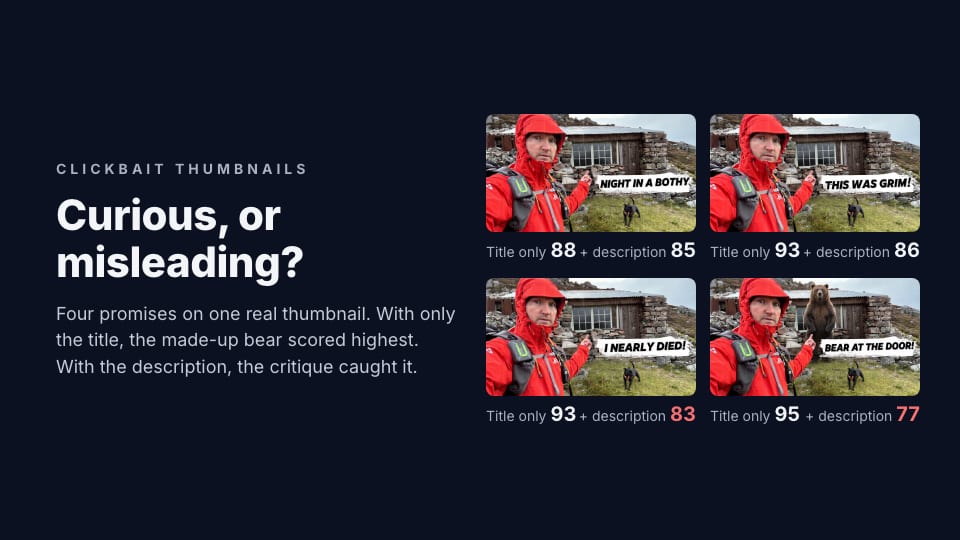
- Keep the title true to the video. YouTube's rules cover misleading titles as well as thumbnails. Our post on clickbait thumbnails quotes them.
- See each title beside your thumbnail. Preview is free and shows your title and thumbnail in a YouTube feed, where a long title is cut short. Put the words that matter first.
- Let YouTube test them. YouTube's own A/B test takes "up to 3 thumbnails and/or titles" and picks the winner by which one got the larger share of watch time. Our A/B testing guide explains how to read the result.
We don't have a title generator. Critique checks how well a title and a thumbnail work together. One check costs 1 credit, and a free account comes with 12 credits.
Frequently asked questions
What is a good YouTube title?
A good YouTube title looks like the titles that viewers in your category already see. On 11,660 real titles, the most common kinds were two parts (38%), a word in capitals (34%) and an exclamation mark (20%). We can't measure clicks, so we can't name one best kind. Read real titles in your own category first: the Categories tab of Breakouts lists them for free.
How long are real YouTube titles?
YouTube allows 100 characters. The median English title in our count was 61 characters, and 51% were longer than 60. Our earlier study of breakouts found a median of 63. Put the important words first, because feeds cut long titles.
Should a YouTube title be a question?
It can be. 10% of titles had a question mark. It was more common in Autos & Vehicles (15%) and Science & Technology (15%) than in Film & Animation (5.5%). Breakouts used questions slightly less than the same channels' ordinary videos (8.7% against 10.6%).
Should I use capital letters in a title?
34% of all titles had at least one word in capitals. The share was 57% in Gaming and 17% in Pets & Animals. Breakouts and ordinary videos used them about equally often (33.4% against 33.9%).
Do "how to" titles still work?
We can't measure clicks, so we can't say which titles work. What we can say is that "how to" is still in use: it was in 9.4% of Howto & Style titles and 2.5% of all titles, and breakouts used it about as often as ordinary videos.
How we measured: we used 2,332 channels from ThumbnailPeak's Breakouts whose titles are English (at least 4 of the channel's 5 titles). For each channel we took its best breakout published 2 to 29 October 2026, which got at least 3 times the channel's usual views. We also took its 4 newest ordinary videos, which got 0.5 to 1.5 times the channel's usual views. That is 11,660 titles, read on 7 November 2026. Channels with a live stream or premiere among the five were left out. Each kind is a fixed rule, counted by a program on 14 November 2026. Seven kinds are exact marks (two parts, a word in capitals, an exclamation mark, a bracket, a question mark, an emoji, a hashtag). For each of the other 17 kinds we read 30 random titles ourselves. For 16 of them, 25 to 30 of the 30 were right. For "truth, secret, exposed, myth", about 20 of 30 were right. Breakouts were compared with the same channel's ordinary titles. The 95% interval comes from drawing the channels again at random 2,000 times. We do not report categories with fewer than 100 channels. Raw rows are deleted within 30 days under YouTube's API rules; only totals are kept.