Disclosure: we make ThumbnailPeak, and this post tests its critique and Edit. Every score below is what the critique returned on 31 October 2026, on our own account. Skip The Junk's thumbnail is published under a Creative Commons licence; the seven other versions are ours, and he didn't make or approve them.
Two pieces of advice come with every YouTube thumbnail face. Put your face in it. And make it react: wide eyes, open mouth, the look people call the "YouTube face".
There is some evidence for faces with feeling. Netflix tested the artwork on its own service and wrote in 2016 that "faces with complex emotions outperform stoic or benign expressions". But that was Netflix's title artwork, not YouTube. And a YouTube number you may have seen, that an expressive face gets 35–50% more clicks than no face, came with no source in the guide where we read it.
So we measured what successful thumbnails do. We found the faces in 21,545 recent thumbnails, labelled the expression on each real face, and compared every channel's best recent video with its ordinary ones. Then we gave one creator's thumbnail six other expressions and ran our critique on each. Here's what we found:
- Half of thumbnails have a face. 50% of 21,545 recent thumbnails had one, from 25% in Pets & Animals to 84% in Comedy.
- The shocked face is rarer than its reputation. It was on 11% of 10,096 real faces, about 1 in 9. A smile (32%, counting laughs) and a serious, focused look (28%) were each more than twice as common. Only 1 face in 10 was exaggerated.
- Breakouts didn't use a different expression. Compared with the same channel's ordinary videos, breakouts were shocked, smiling or open-mouthed just as often.
- Breakouts changed the face a little more often. A breakout showed an expression the channel hadn't used on its other recent thumbnails 39% of the time, against 34% for an ordinary video.
- The face is usually not huge. The biggest face covered a median of 4.9% of the picture.
- Changing the expression barely moved our critique's score. Seven expressions on one thumbnail scored 84 to 86. The critique rated the shocked one the least distinctive, almost as low as the version with no face.
How often successful thumbnails use a face
We took ThumbnailPeak's Breakouts sample on 31 October 2026: 4,309 channels with a video published in October that got at least three times the channel's usual views. We call that video a breakout. For each channel, we took the breakout and its four newest ordinary videos, ones that got about the usual views. That's 21,545 thumbnails, and we found the faces in each with Apple's on-device face detection.
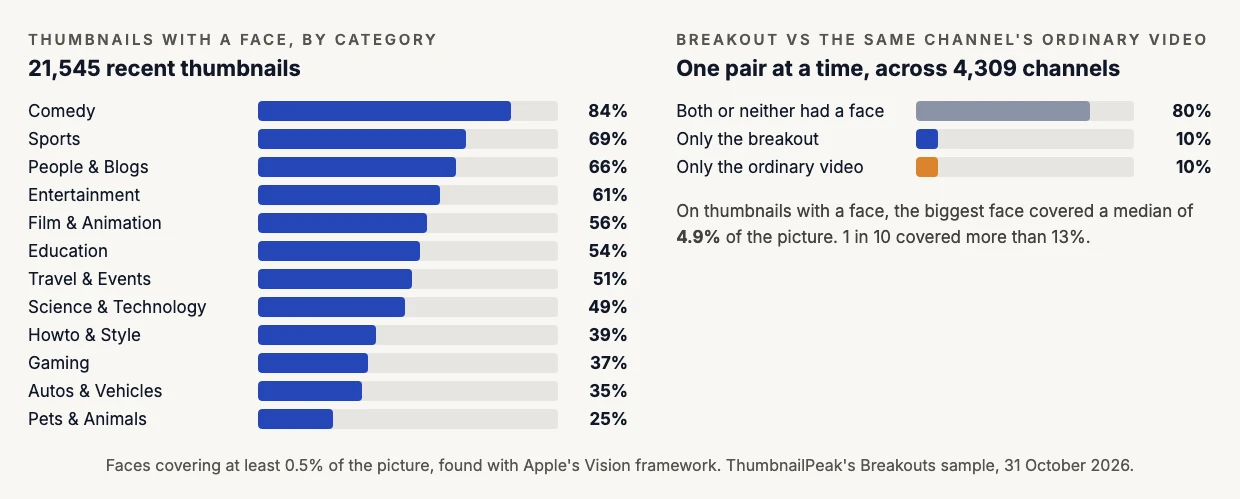
- Comedy, Sports and People & Blogs use faces most: 84%, 69% and 66%. The person is the content.
- Gaming, Autos & Vehicles and Pets & Animals use them least: 37%, 35% and 25%. The game, the car or the animal is the star.
- Two or more faces were in 18% of all thumbnails.
So whether to use a face depends a lot on what your videos are about. A cat channel with a face in every thumbnail would be unusual. A commentary channel without one would be too.
The face isn't always the creator's, either. Film recaps, documentaries and news channels often show the person the video is about: an actor, a CEO, a historical figure. On a faceless channel, it's often a character from the story.
Which expressions successful thumbnails use
For every thumbnail with a face, we cut out the biggest face and had an AI model label it from a fixed list of expressions. It also said how strong the feeling was and whether the mouth was open. We checked the labels by eye on random samples. A second labelling pass over 300 faces gave the same expression for 85% of them, and for 36 of the 41 shocked ones; most disagreements were between a neutral face and a slight smile or a serious look. We left out 712 drawn and 3D characters and 33 faces that couldn't be judged, which leaves 10,096 real faces.
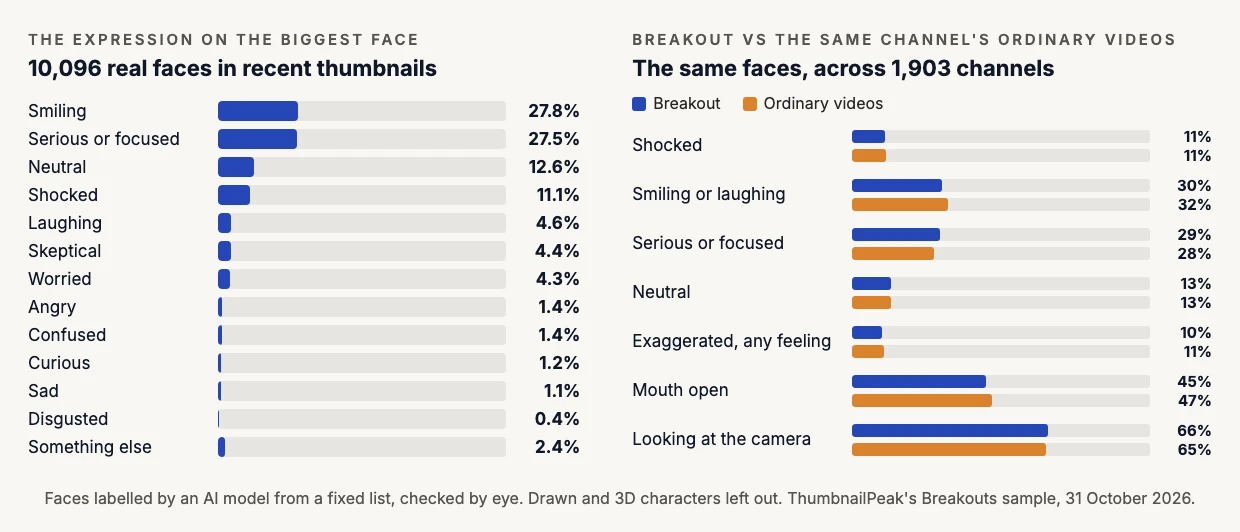
- A smile was the most common face. 28% of faces smiled and 5% laughed. Travel & Events and Howto & Style smiled most, 40% each.
- A serious, focused look was just as common, at 28%. It's the face of someone doing something, or of the person a video is about. Film & Animation (41%), Sports (37%) and Education (35%) used it most.
- Neutral faces, calm with no clear feeling, were 13%.
- The shocked face was on 11%, about 1 in 9. Gaming used it most, on 24% of its faces. Pets & Animals (6%) and Education (7%) used it least.
- Everything else was rare. Skeptical and worried faces were 4% each. Angry, confused, curious and sad faces were about 1% each, and disgusted 0.4%.
- Most faces showed a clear but ordinary feeling. 45% were clear, 34% subtle and 11% showed no feeling at all. Only 10% were exaggerated. 47% had the mouth open, and 65% looked at the camera.
So the "YouTube face" exists, but it's a minority. Most successful thumbnails show someone who looks happy, or looks busy. Some feelings that thumbnail guides suggest trying, like curiosity, confusion or disgust, were each on about 1 face in 100 or fewer.
Breakouts didn't change the expression
If a face made videos take off, a channel's breakout would have one more often than its ordinary videos. It didn't. We compared each breakout with each of its channel's four ordinary videos. In 80% of pairs, both had a face or neither did. Where they differed, the breakout had the face 10% of the time and the ordinary video had it 10% of the time.
The expression didn't differ either. On the 1,903 channels where the breakout and at least one ordinary video had a real face, the breakout was shocked 11% of the time, the same as the ordinary videos. It smiled or laughed 30% of the time, against 32%. An exaggerated face, an open mouth, eyes on the camera: every gap was about 2 points or less, and none was clearly more than chance.
One thing did differ a little: whether the face was new. On the 1,253 channels with a real face on all five thumbnails, we checked whether each thumbnail's expression appeared on any of three others from the same channel. The breakout's expression was new to the channel 39% of the time. An ordinary video's was new 34% of the time. The gap held whether we compared the breakout with the channel's newest videos or its oldest, so it isn't just a channel's style changing over time.
It's a small difference, and a breakout is often a different kind of video, which earns a different face. But it points the same way as the advice to match your expression to each video, not to use one face every time. Only 10% of these channels used the same expression on all five thumbnails.
What doesn't change is whether there's a face at all. Channels that use faces kept using them on their breakouts. Channels that don't, didn't start. The face is part of a channel's look, not the switch that makes a video break out. We found the same for words, colours and the look overall.
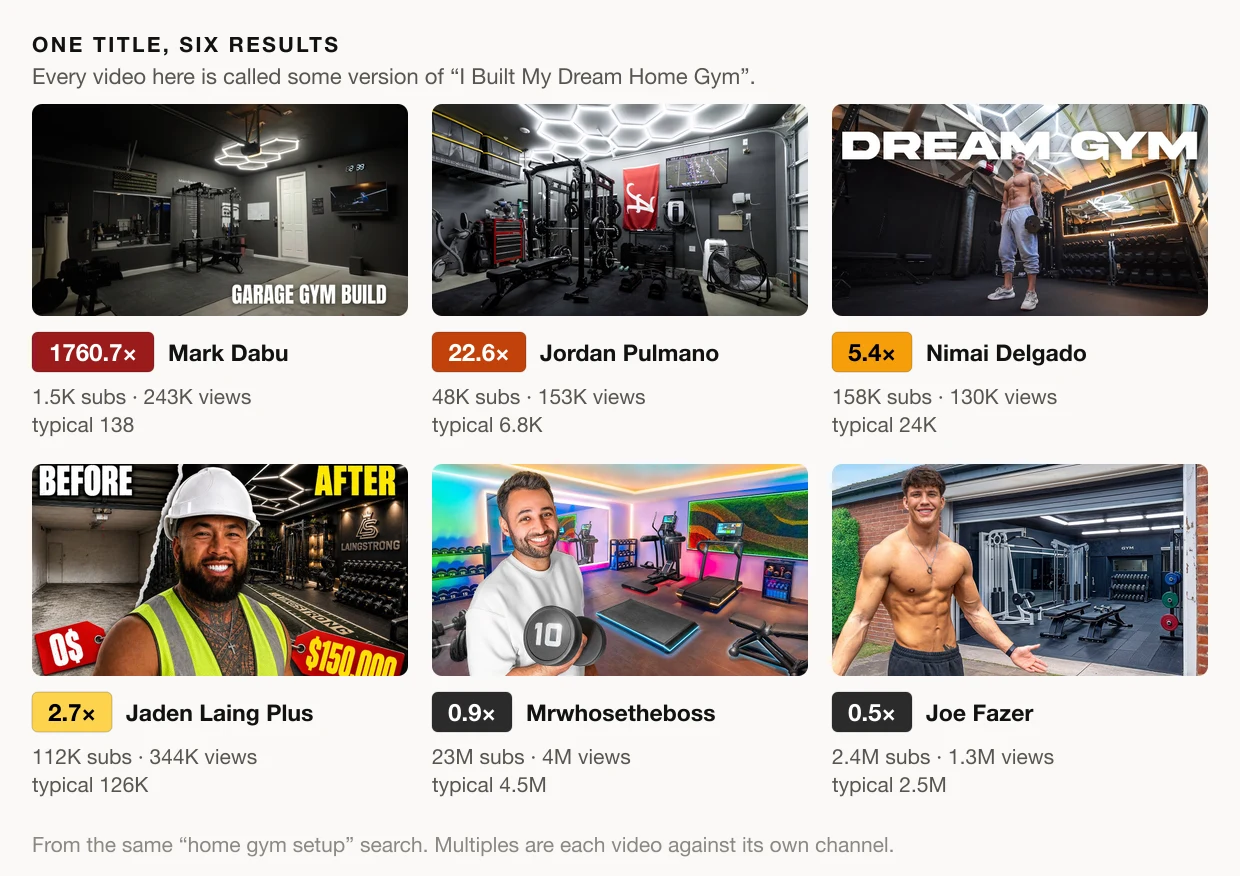
Sometimes the person even gets in the way. When we searched Breakouts for "home gym setup", six videos had almost the same title. The two biggest breakouts, at 1,760 and 22.6 times their channels' usual views, showed the gym and nobody in it. The four with the creator in front of the gym did between 5.4 and 0.5 times their usual. That's six thumbnails, not a rule. But for a video about a place or a thing, showing the thing can beat showing yourself.
How big the face should be
On the thumbnails with a face, the biggest face covered a median of 4.9% of the picture: about 210 by 210 pixels on a 1280×720 thumbnail. A quarter covered more than 8%, and a tenth more than 13%.
That's smaller than the giant reaction face many guides picture. It's because the face is usually one part of a scene: a person beside a car, in front of a hut, holding a loaf of bread. The face shows who and how they feel; the rest shows what the video is about.
What matters more than the size is that the face is readable at 160 pixels wide, the size of a thumbnail on a phone's channel page. At that size, a face that covers 4.9% of the picture is about 27 pixels across: enough for the eyes, mouth and expression to read. Much smaller, and it becomes a dot.
One thumbnail, eight versions
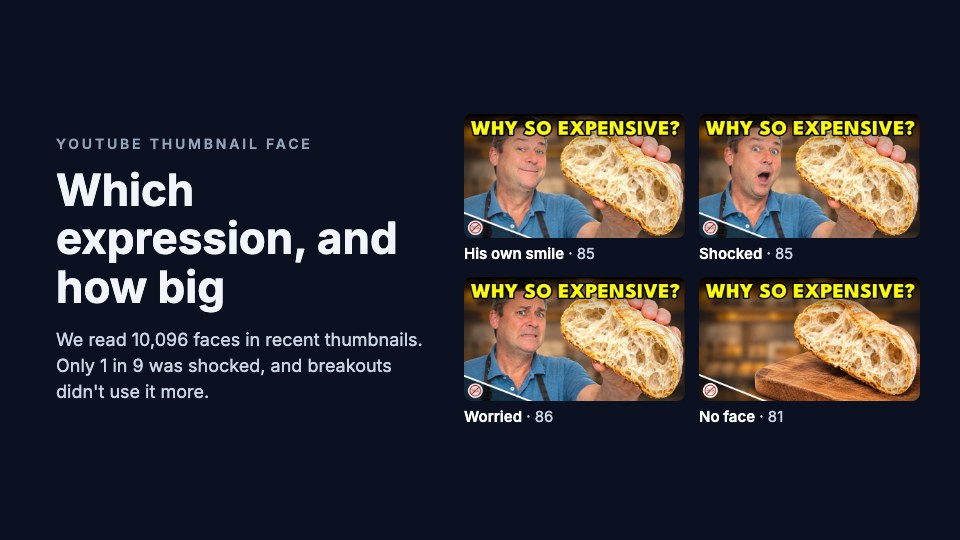
Skip The Junk's thumbnail for "Homemade Ciabatta That Tastes Better Than the Store!" shows the creator with a sly smile, holding a torn-open loaf up to the camera, under "WHY SO EXPENSIVE?" in yellow. With ThumbnailPeak's Edit, we changed only his expression, one request each from the original: shocked, laughing, worried, skeptical, disgusted and neutral. We'd also made a version without him, with the loaf on a wooden board. Then ThumbnailPeak's AI critique scored all eight with the video's title.
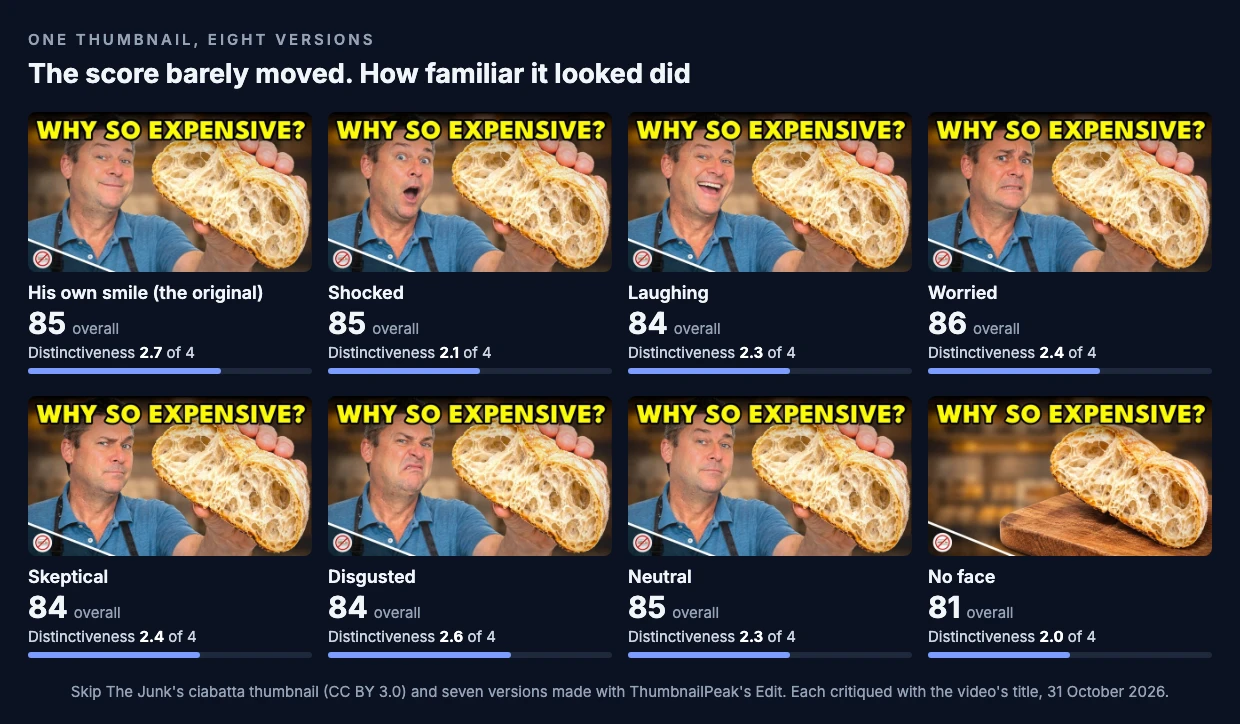
Every version with a face scored 84 to 86. The critique scores each picture seven times and averages the runs, and a difference of a couple of points is within its noise. So the expression didn't change the score. Taking the face out lowered it a little, to 81.
What changed was distinctiveness, the check for how much a picture stands apart from other thumbnails. His own sly smile rated highest, 2.7 of 4. The shocked face rated 2.1, close to no face at all (2.0). The critique's note on it: "The surprised face, oversized food, and bold all-caps headline are familiar recipe-thumbnail elements." The laughing face got much the same note.
So the shocked face isn't a score booster. The critique read it as a stock reaction, one that made this thumbnail look more like other food thumbnails. His own expression was what made this one his.
One thing the critique missed was the disgusted face. A man grimacing at bread his title says "tastes better than the store" tells the viewer the wrong story. The critique still scored it 84, and called his "strong expression" "a clear visual hook". It judges the picture and the title, not your video. Whether the feeling on your face matches what happens in the video is your call.
Which face to put in your YouTube thumbnail
Use a face when:
- You are the content. Commentary, vlogs, reactions, challenges: the viewer is choosing you.
- The feeling is the hook. A shocked, worried or delighted face tells the viewer what kind of moment the video has. YouTube's own tips for thumbnails suggest actions and emotions "that are more universally relatable" for viewers who don't know you yet.
- Your face is your channel's look. If your subscribers know your face, it helps them spot your next video. Our guide to thumbnail branding covers that.
Leave it out, or keep it small, when:
- The thing is the content. A car, a build, a gym, a recipe, an animal. Show the thing big; put yourself beside it if at all.
- It competes with the subject. A face and an object the same size split the viewer's attention. Make one of them clearly bigger. Our composition guide shows what that costs.
Choose the expression from the video:
- Show the feeling the video delivers. A real surprise can earn a shocked face. A tutorial earns a focused one, and a win earns a smile.
- Don't default to shocked. It's on 1 in 9 successful faces, breakouts didn't use it more, and our critique rated it the most familiar. A reaction the video doesn't deliver is a clickbait thumbnail.
- Make it clear, not extreme. Only 1 in 10 successful faces was exaggerated. The face has to read at phone size, not look like a cartoon.
- Change it when the video changes. The same smile on every video tells the viewer nothing new. Breakouts were a little more likely to show a face the channel hadn't just used.
- Keep it yours. Your own natural expression is something no other channel has. In our test, the critique rated it the most distinctive of seven.
And keep the face out of the bottom-right corner, where YouTube draws the video's length.
To try a different expression without a new photo shoot, ThumbnailPeak's Edit changes it from one sentence, like "Change only his expression to worried", and keeps the rest of the picture. An edit uses 3 credits, and a free account comes with 12. Compare can then critique two versions against the same title, and YouTube's Test & Compare shows which one viewers watch more.
No time for a photo shoot for every video? ThumbnailPeak's AI thumbnail maker can put you in every thumbnail it makes from a few photos in its face library, with the expression each idea needs. We tested which photos to add: one clear photo was enough to be recognisable.
Frequently asked questions
Do YouTube thumbnails with faces get more views?
We didn't find that. Across 4,309 channels, breakouts had a face no more often than the same channel's ordinary videos. Faces are common, in half of recent thumbnails, but they're part of a channel's style rather than what made a video take off.
What is the best facial expression for a YouTube thumbnail?
The one that matches the feeling of your video. No expression was more common on breakouts than on the same channel's ordinary videos. On successful thumbnails, the most common faces were a smile (32%, counting laughs) and a serious, focused look (28%). A shocked face was on 11%.
Should I use a shocked face in my thumbnail?
Only if the video has a moment that earns it. Shocked faces were on 1 in 9 successful thumbnails with a face, and breakouts didn't use them more often. In our critique, a shocked face scored the same as six other expressions and was rated the least distinctive. The same shocked face on every video stops meaning anything.
How big should my face be in a thumbnail?
Big enough to read at 160 pixels wide. On successful thumbnails with a face, the biggest face usually covered about 5% of the picture, and only 1 in 10 covered more than 13%. If the video is about you, go bigger; if it's about a thing, show the thing bigger.
Can I change my expression in a thumbnail without a new photo?
Yes. ThumbnailPeak's Edit changed the creator's expression six ways in our test, one sentence each, and left his face, the bread and the words as they were. Make each change from your original picture, not from the last edit: edits made on top of edits drift the face away from yours.
How we did it: the 21,545 thumbnails come from ThumbnailPeak's Breakouts sample on 31 October 2026: for each of 4,309 channels with a video published 3 to 29 October at three times or more its usual views, that breakout and the channel's four newest ordinary uploads that were at least two weeks old and got 0.5 to 1.5 times its usual views. We read each thumbnail at 640×360. Faces were found with Apple's Vision face detection on our own computer, counting faces that cover at least 0.5% of the picture with the detector at least 50% confident. The biggest face in each thumbnail was cut out with a margin around it and labelled by OpenAI's GPT-6 Luna from a fixed list of 12 expressions plus "something else", with how strong it was and whether the mouth was open; 712 drawn or 3D characters, and 33 faces too small or blurred to judge or that weren't faces, were left out. Breakouts were compared with their own channel's ordinary videos, and we checked each gap against chance by resampling channels. Our earlier sample of 17,609 thumbnails on 22 October had no Gaming, Entertainment or Howto & Style channels; it found a face in 55% and a median face size of 4.5%. The home gym thumbnails come from our Breakouts walkthrough and belong to their creators. The ciabatta thumbnail is Skip The Junk's, published under CC BY 3.0. We changed his expression with ThumbnailPeak's Edit on 31 October, one request per expression, each from the original, and removed him with one request on 22 October. All eight versions were critiqued once with the video's title on 31 October 2026.