Disclosure: we make ThumbnailPeak, and this post tests its critique. Every score below is what it returned on 22 October 2026, on our own account. The three videos are published under a Creative Commons licence by Walk With Wallace, Skip The Junk and Scott and Liza Redefined.
Before you add words, arrows or colours, a thumbnail is one picture. Choosing it is the biggest decision you make, and it's often made by default: a frame grabbed from the video, or the one YouTube suggests.
We tested what that default is worth. Here's what we found:
- Almost nobody uses YouTube's frames. YouTube saves three still frames from every video. Of 7,052 recent thumbnails we checked, only 2% were one of them, and among breakouts only 1.6%. YouTube's own help page says 90% of the best-performing videos have custom thumbnails.
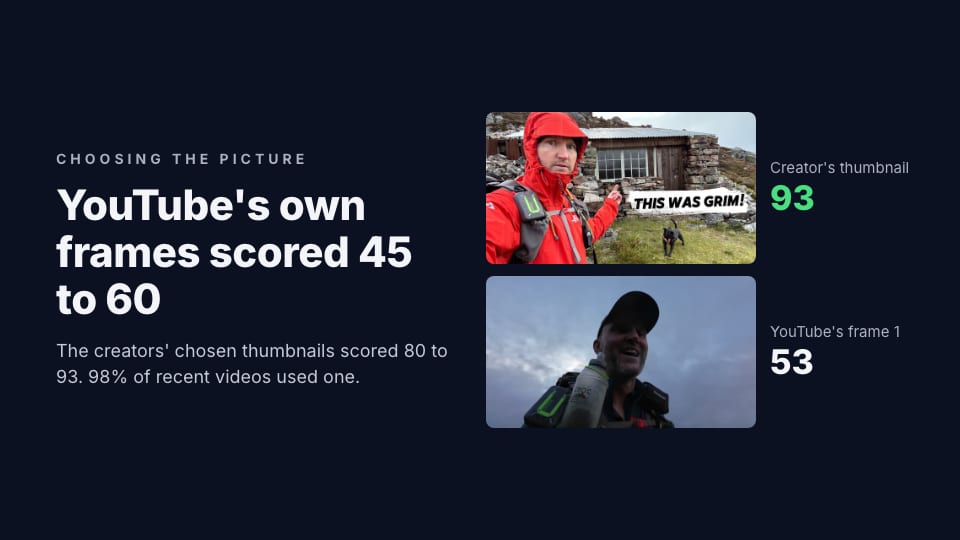
- The frames scored far lower. We critiqued YouTube's three frames from three videos. They scored 45 to 60. The creators' own thumbnails for the same videos scored 80 to 93.
- The reason was the same every time. The frames showed an ordinary moment from the middle of the video, not what the title was about. For a video about a night with a dog in a mountain hut, all three frames showed the creator, and none showed the dog or the hut.
Almost every successful thumbnail is a chosen picture
When you upload a video, YouTube picks still frames from it, and it keeps three of them as images for every video. A frame like these is what you get if you don't make a thumbnail of your own.
We checked how often creators actually use them. From ThumbnailPeak's Breakouts sample on 22 October 2026, we took 3,525 recent breakouts, videos that got at least three times their channel's usual views, and one ordinary recent video from each of the same channels. For each video, we compared its thumbnail with YouTube's three saved frames.
Only 58 of the breakouts (1.6%) and 98 of the ordinary videos (2.8%) used one of the frames as it was. The other 98% used a picture they chose or made. That fits YouTube's own thumbnail tips, which say: "90% of the best-performing videos have custom thumbnails."
YouTube's frames against the creators' thumbnails
To see why, we took three videos and ran all three of YouTube's saved frames, at 1280×720, through ThumbnailPeak's AI critique, each with the video's real title. Then we ran the creator's own thumbnail the same way.
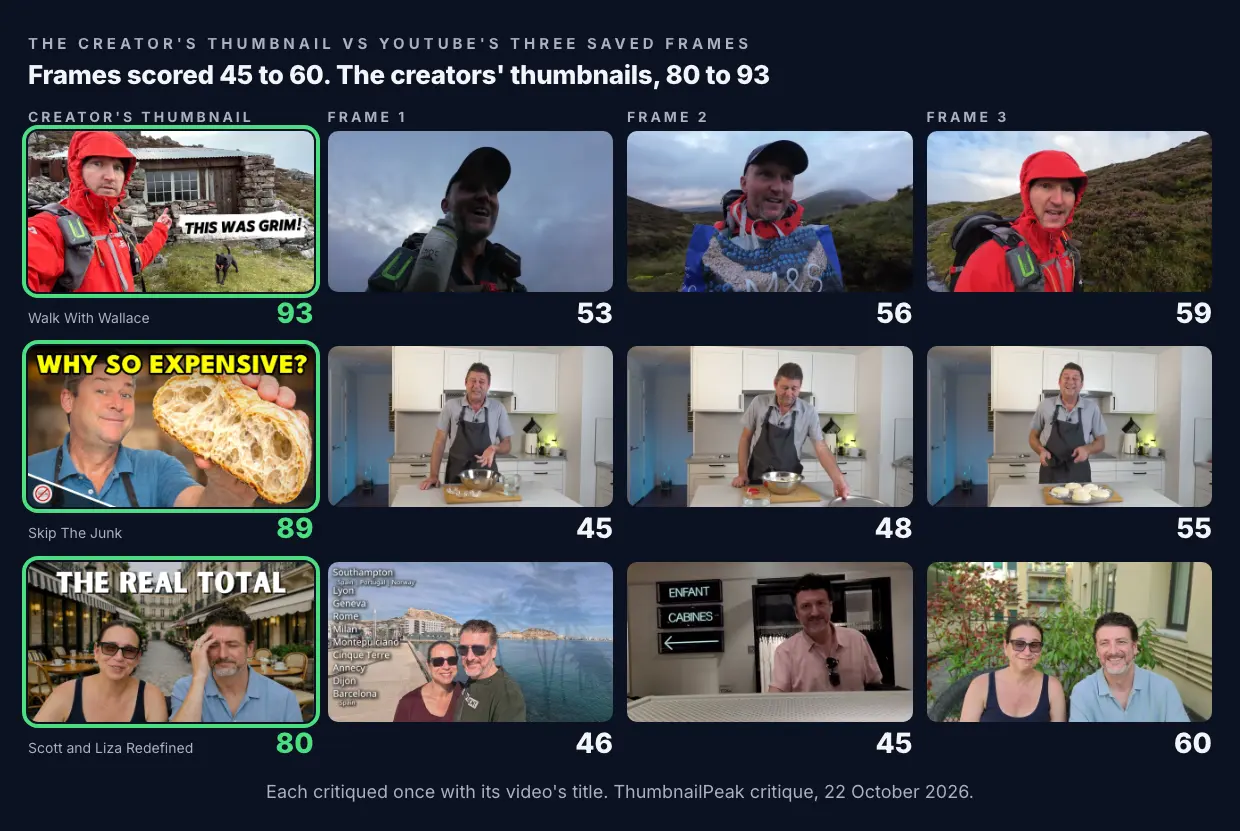
- Walk With Wallace, "Overnight ALONE with my Dog in a TINY Mountain Bothy": his thumbnail scored 93. The frames scored 53, 56 and 59.
- Skip The Junk, "Homemade Ciabatta That Tastes Better Than the Store!": his thumbnail scored 89. The frames scored 45, 48 and 55.
- Scott and Liza Redefined, "One Year of Slow Travel in Early Retirement: Full Cost Breakdown": their thumbnail scored 80. The frames scored 46, 45 and 60.
The frames weren't bad photos. Most were sharp, well lit and showed the creator clearly. They lost for a different reason.
Why the frames lost
A frame from the middle of a video shows what was happening at that second, and most seconds of a video are ordinary. The critique said so in almost the same words each time:
- On a frame of Walk With Wallace hiking: "The title promises a night alone with a dog in a tiny mountain bothy, while the thumbnail shows only a person hiking in daylight."
- On a frame of Skip The Junk at the start of his recipe: "The title promises homemade ciabatta, but the thumbnail shows only a presenter and an empty-looking mixing bowl."
- On a frame of Scott and Liza sitting outside: "The thumbnail does not visibly communicate one year, early retirement, slow travel, or costs."
Seven of the nine frames got 1 or 2 out of 4 for matching the topic. All nine got 2 or less for curiosity, and six got 1: nothing in them gave a reason to click. The creators' thumbnails each showed the thing the title was about: the hut and the dog, the torn-open loaf, the two of them at a café under "THE REAL TOTAL", him with a hand to his forehead.
Note what those three thumbnails are, too. None is a random frame. Walk With Wallace's is a posed selfie, pointing at the hut with the dog in shot. Skip The Junk's is the finished loaf held up to the camera. Scott and Liza's is a posed photo of the two of them. Each was set up for the thumbnail.
How to choose the picture
- List what your title promises. Write down the nouns: a dog, a hut, a loaf, a bill. The picture has to show the main one, big enough to recognise at 160 pixels wide.
- Show the moment, not the setup. The finished loaf, not the mixing bowl. The storm, not the walk in. A viewer clicks for the moment the video builds to, without the ending given away.
- Take the photo on the day. YouTube's own tips suggest taking several photos during the shoot so you have thumbnail options. A posed photo of you with the subject almost always beats a frame grabbed later.
- If you use a frame, choose it. Step through the footage for a frame where the subject is big and in focus and your face shows what the moment felt like. Avoid mid-blink, mid-word and motion blur. Our guide to blurry thumbnails shows what a soft frame costs.
- Build it if no single picture works. Cut the subject out and put it on a clean background, or combine two pictures: a before and an after, the problem and the result.
- Check it against the title. ThumbnailPeak's critique reads your title and grades whether the picture shows what it promises. 13% of the 4,925 thumbnails critiqued on ThumbnailPeak from 15 August to 22 October 2026 got a fix telling them to show the video's topic.
Once you have the picture, the rest is arrangement: where things go, how many words, and whether to put your face in it.
When you don't have the picture
Sometimes the moment wasn't photographed, or the video isn't filmed yet. ThumbnailPeak's AI thumbnail generator designs a thumbnail from your video's link, using its title, description and frames, or from a description of a video you haven't uploaded. It works from the video's own frames and settings. Our Generate guide shows what it makes, and this post covers making a thumbnail before you film.
Frequently asked questions
Should I use YouTube's auto-generated thumbnail?
Only if nothing else is possible. In our test, YouTube's saved frames scored 45 to 60, against 80 to 93 for the creators' own thumbnails, because they showed an ordinary moment rather than what the video is about. Only 1.6% of recent breakouts used one.
What makes a good thumbnail picture?
It shows what the title promises, big enough to recognise at small sizes, at the moment the video builds to. A posed photo taken for the thumbnail usually beats a frame from the video.
Can I use a screenshot from my video as the thumbnail?
Yes, if you choose it: a frame where the subject is big, sharp and clearly about the title. Most creators who use a frame then crop it, add words or brighten it.
Can I use stock photos for a YouTube thumbnail?
You can, if the licence allows it, but a stock photo can't show your video. Viewers who click for a picture that isn't in the video feel misled. Use your own footage or photos where you can.
How we did it: YouTube's saved frames are the stills it stores for every video at i.ytimg.com (named 1, 2 and 3). For the 7,052 videos, from ThumbnailPeak's Breakouts sample on 22 October 2026 (a breakout published 2 to 20 October at three times or more its channel's usual views, and one recent ordinary video from the same channel), we compared each thumbnail with its three frames at 320×180 using Apple's Vision image feature prints on our own computer, and counted a match when the closest frame was within 0.5; we checked the closest matches by eye. The three test videos are Walk With Wallace's "Overnight ALONE with my Dog in a TINY Mountain Bothy", Skip The Junk's "Homemade Ciabatta That Tastes Better Than the Store!" and Scott and Liza Redefined's "One Year of Slow Travel in Early Retirement: Full Cost Breakdown", all published under CC BY 3.0. Each frame and thumbnail was critiqued once with its video's title on 22 October 2026. The ThumbnailPeak counts cover thumbnails critiqued from 15 August to 22 October 2026, each picture once, with our own account's critiques left out.