Disclosure: we make ThumbnailPeak, and this post tests its critique. Every score below is what it returned on 22 October 2026, on our own account. The thumbnail is Walk With Wallace's, published under a Creative Commons licence; the three changed versions are ours, and he didn't make or approve them.
Every thumbnail worth clicking makes a promise. "THIS WAS GRIM!" over a man pointing at a stone hut promises a story about a night that went wrong. If the video tells that story, the thumbnail did its job. If it doesn't, the thumbnail was clickbait.
So the line between curious and misleading isn't in the thumbnail. It's between the thumbnail and the video. Here's what we found when we tested that:
- YouTube draws the line at "malicious" clickbait. Its policy bans thumbnails meant to "trick users into clicking", and in December 2024 it said it would start removing videos whose title or thumbnail promises something the video doesn't deliver, beginning in India.
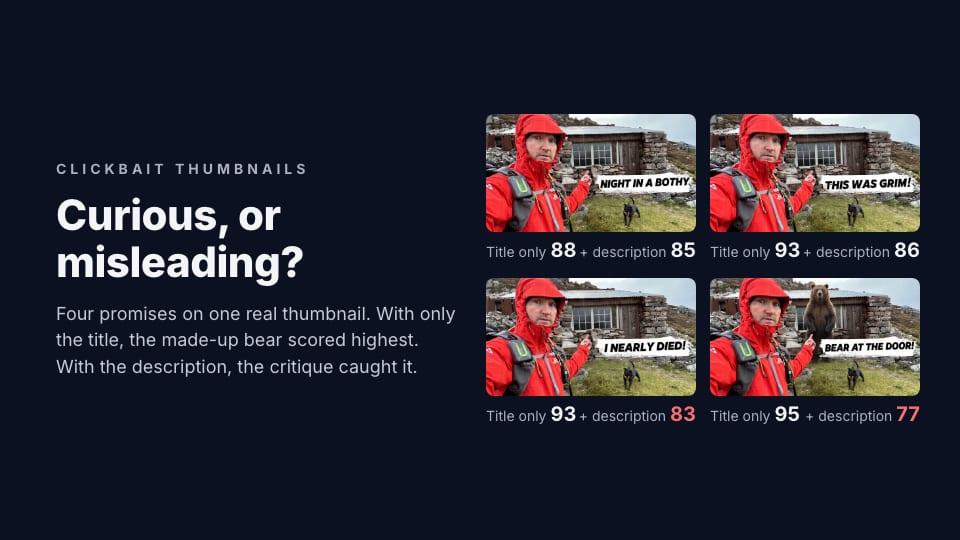
- Our critique couldn't tell honest from misleading when it had only the title. We made four versions of one real thumbnail. "I NEARLY DIED!" scored 93, the same as the real one, and a bear that isn't in the video scored highest of all, 95.
- Given the video's description, it caught both. "I NEARLY DIED!" dropped to 83, with a fix to remove it. The bear dropped to 77, and the part of the score about the title fell to 38 out of 100.
- 1 in 4 creators' thumbnails were told they promise something else. Of 3,324 thumbnails critiqued on ThumbnailPeak with a title, 843 got a fix to bring the promise in line with the title or to remove a misleading element.
What YouTube counts as clickbait
YouTube doesn't ban curiosity, exaggerated faces or big words. Its spam, deceptive practices and scams policy lists "malicious clickbait": "using maliciously misleading titles, thumbnails, descriptions, or imagery to trick users into clicking on a video." Its example is a title that offers a full sports match when the video shows only a clip.
In December 2024, YouTube said it would also act on "egregious clickbait": videos whose title or thumbnail promises something the video doesn't deliver, especially about breaking news. Its examples, as TechCrunch reported them, were a video titled "The President Resigned!" that never covers a resignation, and a thumbnail reading "Top Political News" on a video with no news in it. It started in India, removing videos without giving the channel a strike.
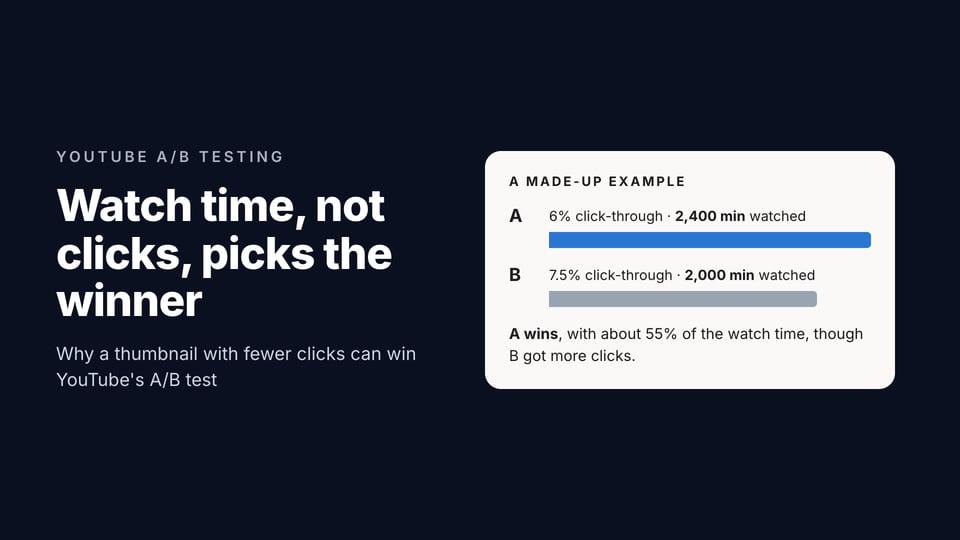
Those are the extremes. Most clickbait never comes near them. It's a thumbnail that promises a bigger moment than the video has, and the cost isn't a removal. It's viewers who click, don't find what they were promised, and leave. YouTube's own A/B test picks a winner by watch time, not clicks, so a thumbnail that wins the click and loses the viewer can lose the test too.
Curiosity isn't clickbait
A curious thumbnail leaves something out. A misleading one adds something that isn't there.
Walk With Wallace's thumbnail for "Overnight ALONE with my Dog in a TINY Mountain Bothy: Things Didn't Go To Plan!" is a good example of the first kind. It shows the creator in a red rain jacket, pointing at a tiny stone hut, his dog in the grass, under the words "THIS WAS GRIM!". It doesn't say what went wrong. You'd have to watch to find out.
And the video delivers. Its description starts: "This was a bit of a disaster! Join me and my dog, to survive the night in a stone shelter bothy built into the side of a mountain. It was wet and windy, and things just didn't go to plan." The thumbnail promises a grim night, and the video is a grim night. It has more than 600,000 views, by far the most on a channel whose videos usually get a few thousand.
One thumbnail, four promises
To see where the line sits, we kept his photo and changed only the promise. With ThumbnailPeak's Edit, we made three versions of his thumbnail:
- "NIGHT IN A BOTHY": plain and accurate, with no tease.
- "THIS WAS GRIM!": the real thumbnail.
- "I NEARLY DIED!": the same night, overclaimed. Nothing in the description suggests he was ever in danger.
- "BEAR AT THE DOOR!", with a brown bear standing by the hut: something that isn't in the video at all. There are no wild bears in Scotland.
Then we ran each one through ThumbnailPeak's AI critique twice: once with only the video's title, and once with the title and the first lines of its description.
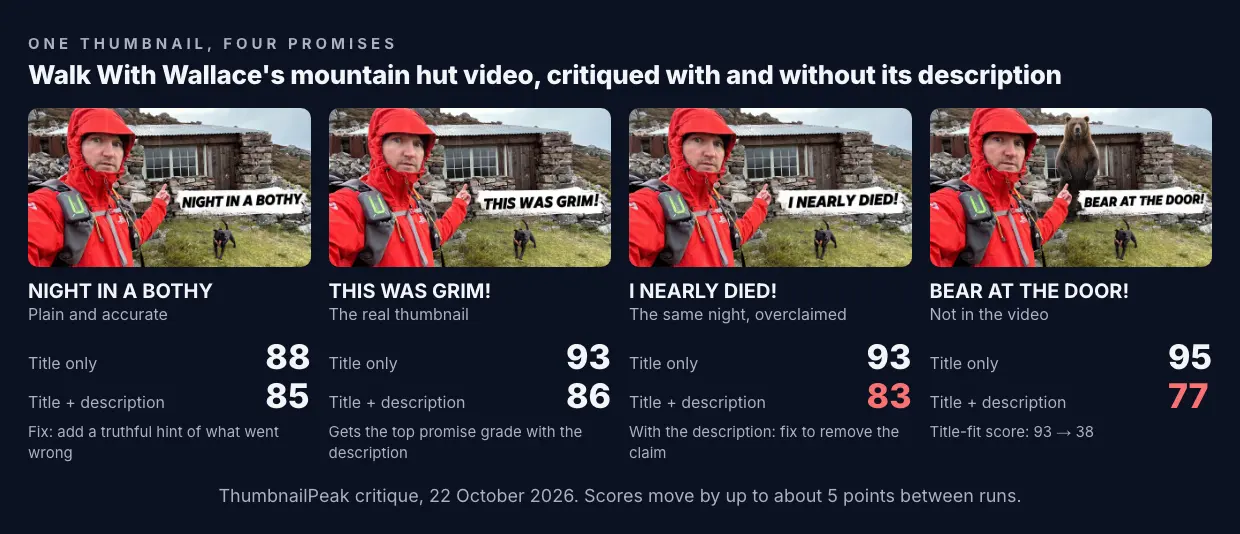
With only the title, the misleading versions did best. The title says "Things Didn't Go To Plan!", and a bear at the door is a thing not going to plan. The critique gave the bear version 95, the highest of the four, and "I NEARLY DIED!" 93, the same as the real thumbnail. It wasn't fooled completely: it marked the bear down for looking "cutout-like" and "composited", and noted that "I NEARLY DIED!" was "highly dramatic compared with the otherwise documentary-looking scene". But it had no way to know whether either claim was true.
With the description, it caught both. "I NEARLY DIED!" fell to 83. The critique said the headline "is more extreme than the stated disaster and bad-weather premise", and its top fix was to remove it:
Remove the misleading element. The headline makes an extreme claim while the visible scene only shows a person outside a bothy in bad weather. Replace it with a specific, supported line such as "THINGS WENT WRONG" or name the actual problem from the video.
The bear fell to 77. Its score for matching the title collapsed from 93 to 38, because, in the critique's words, "BEAR AT THE DOOR! promises a bear encounter, while the stated video promise is an overnight bothy disaster involving the creator and his dog." Its fix: "Replace the bear and banner with a real image from the wet, windy bothy night."
The real thumbnail held up. It scored 93 with the title and 86 with the description, and the description raised its promise grade to the top mark: "The worried expression and THIS WAS GRIM! directly support the summary's claim that the wet, windy night went badly." Scores move by up to about 5 points between runs, so 86 and 93 are closer than they look. What matters is that the honest version kept the top promise grade when the critique knew the facts, and the two misleading ones didn't.
Plain was honest, and less interesting. "NIGHT IN A BOTHY" scored 88 and 85. Nothing was wrong with it, but both times one of the critique's fixes was to strengthen the promise: "Add one clear, truthful visual cue of the problem." Its suggested words, "BOTHY NIGHT GONE WRONG", are close to what the creator actually wrote.
Why the description mattered
No tool can watch your video before you upload it, and the critique doesn't try. It judges your thumbnail against what you tell it the video is. With a title like "Things Didn't Go To Plan!", almost any disaster fits, so a made-up one passes. With a description that says what actually happened, a made-up disaster stands out.
We saw the same thing across creators' thumbnails. Of the 3,324 thumbnails critiqued on ThumbnailPeak with a title, the 432 that came with a description were twice as likely to get a fix to remove a misleading element: 11% against 5%. That's a correlation, not a test. People who paste in a description may also make different thumbnails. But it fits what happened to the bear.
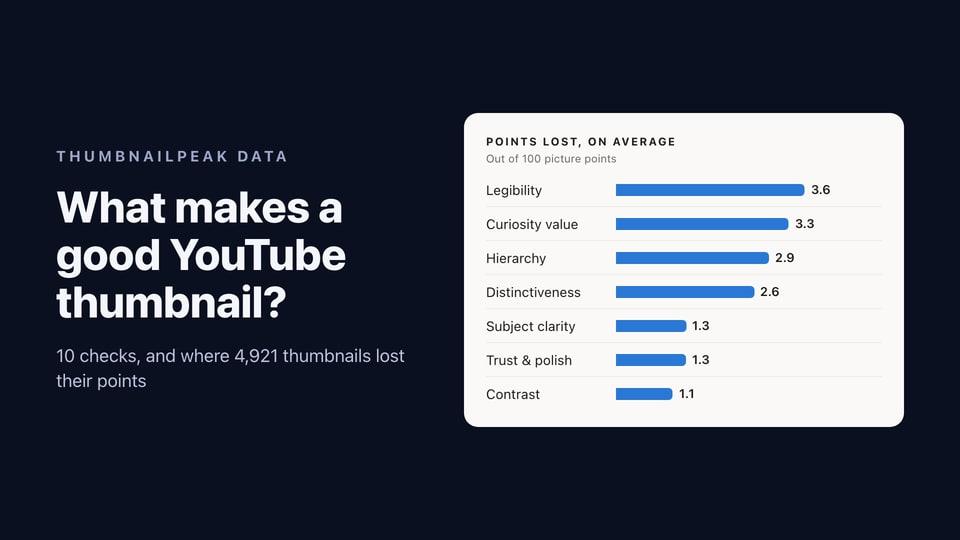
Promises were the weakest part of most thumbnails. Only 24% got the critique's top grade for keeping the title's promise, compared with 59% for showing the right topic. Among all 4,925 thumbnails, 15% got the top grade for looking trustworthy and polished, the second lowest of the seven picture checks.
How to make a thumbnail curious without misleading
- Tease, don't invent. Leave out how the story ends, but only show things that happen in the video. If a bear isn't in the video, it can't be in the thumbnail.
- Match the size of the claim to the size of the moment. "THIS WAS GRIM!" and "I NEARLY DIED!" are about the same night. One describes it; the other inflates it.
- Make the payoff come early. If the thumbnail's moment comes 12 minutes in, viewers who clicked for it may not wait. After you upload, look at how many viewers are still watching after the first 30 seconds, in YouTube Studio's audience retention report. A steep early drop can mean the video didn't start with what the thumbnail promised.
- Give the critique your description. Paste the first lines of your description, or a sentence saying what happens in the video, along with your title. That's what let it catch the overclaims here.
- Compare an honest version with a curious one. If you're torn between a safe thumbnail and a bolder one, Compare critiques both against the same title and description and says which is stronger and why.
Frequently asked questions
Is clickbait allowed on YouTube?
Curiosity is. YouTube's policies ban "maliciously misleading" thumbnails and titles that "trick users into clicking", and since December 2024 it has said it will remove videos with egregious clickbait, such as a title promising news the video doesn't contain, starting in India.
Does YouTube punish clickbait thumbnails?
YouTube removes videos that break its clickbait policies. Short of that, its own A/B test picks thumbnails by watch time rather than clicks, and its recommendations draw on viewer feedback such as satisfaction surveys, so a thumbnail that disappoints viewers works against itself.
What's the difference between clickbait and a curiosity gap?
A curiosity gap leaves something out that the video answers. Clickbait promises something the video doesn't have. "THIS WAS GRIM!" on a video about a grim night is a curiosity gap. A bear on the same video is clickbait.
Can a thumbnail be too honest?
It can be too plain. Our "NIGHT IN A BOTHY" version was accurate but gave no reason to click, and the critique's fix was to add a truthful hint of what went wrong.
How we did it: the thumbnail is from "Overnight ALONE with my Dog in a TINY Mountain Bothy: Things Didn't Go To Plan!" by Walk With Wallace, published under CC BY 3.0. We made the three changed versions with ThumbnailPeak's Edit, one request each; the bear and the new words are ours, not the creator's. Each version was critiqued once with the video's title, and once with the title and the first three sentences of its description, on 22 October 2026. The ThumbnailPeak counts cover thumbnails critiqued from 15 August to 22 October 2026, each picture once, with our own account's critiques and the critiques our tools run on their own results left out. YouTube's policy pages were read on 22 October 2026.