Disclosure: we make ThumbnailPeak, a set of tools for testing thumbnails before you publish. ThumbnailPeak can't see your channel's analytics, so every figure about CTR in this post is YouTube's own, from its help pages, read on 21 October 2026.
A good click-through rate on YouTube is one that's good for that video, from that place, at that moment. That sounds like a dodge, but it's YouTube's answer too. Its help page gives one range for the whole platform:
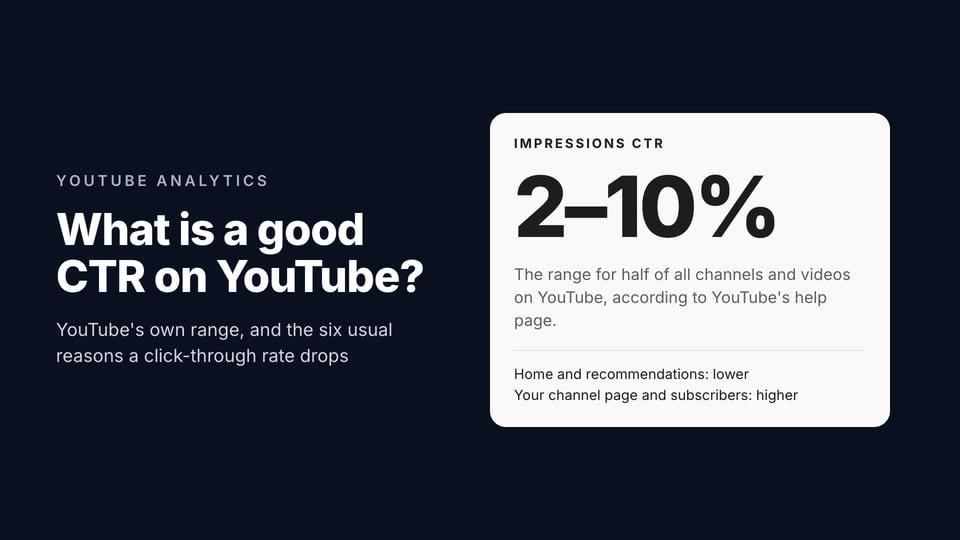
Half of all channels and videos on YouTube have an impressions CTR that can range between 2% and 10%.
So a CTR of 4% is ordinary. So is 8%. Lists that say "aim for 10%" or "anything under 5% is bad" are someone's sample, not YouTube's numbers, and they leave out the things that move CTR most: where the impressions came from, and how many there were.
Here's the short version:
- CTR is views from thumbnail impressions divided by thumbnail impressions. It only counts thumbnails YouTube shows in its own apps and on its website on computers, for more than a second, at least half on screen.
- Home and recommendations bring lower CTRs than your channel page or subscribers. More impressions usually means a lower CTR, and that's often good news.
- Compare a video's CTR with your own videos', over weeks, from the same traffic sources. Not with other channels, and not in the first hours.
- A high CTR with short watch times is a warning, not a win. YouTube calls that pattern clickbait, and it recommends those videos less.
What CTR counts
In YouTube Analytics, CTR is short for impressions click-through rate: how often people watched a video after seeing its thumbnail on YouTube. You'll find it in YouTube Studio under Analytics, then the Content tab, or on a single video's Reach tab.
An impression is counted when a thumbnail is on screen for more than one second with at least half of it visible. YouTube counts impressions in:
- YouTube on computers, phones, tablets, TVs and game consoles
- search results
- the Home page, autoplay included
- feeds: Subscriptions, Trending, History and Watch Later
- the recommendations beside or below a video (Up next)
- playlists
It doesn't count them on other websites and apps where your video is linked or embedded, on YouTube's mobile website, in YouTube Kids or YouTube Music, in end screens and cards, in emails and notifications, or in video discovery ads.
That's why your views and your impressions don't add up to your CTR. Plenty of views don't start from a counted impression: a link in a Discord server, an end screen, a notification. CTR only looks at the views that did.
Why one number can't tell you if yours is good
Where the impressions came from. People scrolling Home didn't come looking for you, so a small share of them click. People on your channel page or in their Subscriptions feed already know you. YouTube says a video shown a lot on the Home page will naturally have a lower CTR, and one whose impressions come mostly from your channel page may have a higher one.
How many impressions there were. YouTube says it's common for videos with fewer impressions to have higher CTRs, because a narrower, more loyal audience saw them. As YouTube shows a video to more people, it reaches more who don't know you, and the rate goes down.
How old the video is. A new video's early impressions are more likely to go to people who already watch your channel. YouTube says new videos and channels (less than a week old) and videos with fewer than 100 views can show "an even wider range" than 2–10%.
What the video is up against. A thumbnail always competes with the others on the same screen. The same thumbnail can do well in a quiet search and badly in a crowded Home feed.
Put together, a 3% CTR on a video YouTube is pushing to thousands of strangers can be a better result than 12% on a video only your subscribers saw.
Why your CTR dropped
Most drops have an ordinary cause. Check these in order, in the video's Reach tab.
- YouTube started showing the video to more people. Look at impressions. If impressions went up and CTR went down, the video is reaching people who don't know you yet, and total views from impressions often went up too. This is usually good news.
- The traffic came from somewhere else. Look at the traffic sources. A video that moved from Search and Subscriptions to Home and Suggested will have a lower CTR even with the same thumbnail.
- The first wave of regular viewers has passed. A new upload's early impressions are more likely to go to people who already watch you, and they click often. Later, more of them go to people who haven't watched you before.
- You looked too early, or at too few impressions. YouTube advises against reading CTR right after uploading, and against reacting to small changes. A move from 6.1% to 5.4% on a few thousand impressions is normal variation.
- There's more competition. A big video on the same topic, or a busy season in your niche, puts stronger thumbnails beside yours.
- The thumbnail or the title isn't working. If the video gets as many impressions as usual, from the same sources, and CTR is still clearly lower than your other videos', the packaging may be the problem.
Only the last one is about the thumbnail. Fixing a thumbnail won't help with the first five.
What to do about a low CTR
Compare it with your own videos, from the same sources. YouTube's own advice is to compare CTRs between videos over the long term, keeping in mind how traffic sources affect them. Your Search CTR against your other videos' Search CTR. Your Home CTR against your Home CTR.
Look at views from impressions, not only CTR. A lower rate on many more impressions can still bring more views. That's the number that pays.
Watch average view duration next to CTR. YouTube says it recommends a video to viewers "if the video is relevant to them and if the video's average view duration indicates that viewers find it interesting". It describes clickbait as a thumbnail with a high CTR, a low average view duration and fewer impressions than expected. Clickbait videos tend to get recommended less, so raising CTR with a misleading thumbnail can cost you more than it gains.
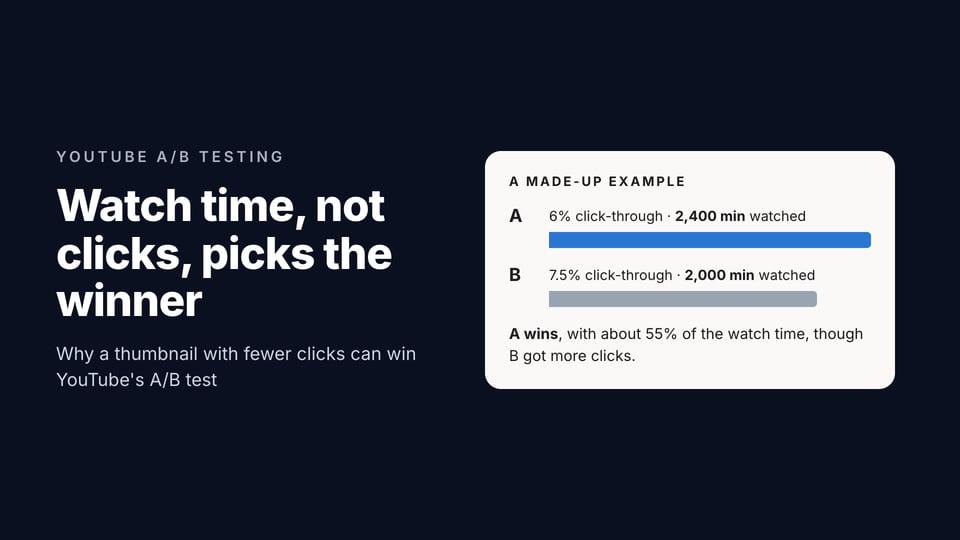
If you want to try a new thumbnail, test it properly. Don't swap the thumbnail and compare this week's CTR with last week's. YouTube advises against that too: you can't be sure both weeks reached the same audience, so the difference may come from the traffic sources, not the thumbnail. Use YouTube's own A/B test, which shows up to three thumbnails at the same time and judges them by watch time. Here's how YouTube's thumbnail A/B test works, and why it picks by watch time, not CTR.
Before the next upload, check the thumbnail at the size people see it. A thumbnail that looks great full screen can be unreadable at 160 pixels wide on a phone's channel page. ThumbnailPeak's thumbnail tester puts yours in a YouTube feed beside the real videos that rank for your title, on a computer, a phone and a TV. It's free and needs no account. With a free account, the AI critique scores it out of 100 on ten checks and lists what to fix first.
One thing no tool can do, ours included, is tell you what CTR a thumbnail will get. The critique grades the picture and how well it fits the title, and it's told not to predict click-through rate. Your CTR depends on who YouTube shows the video to, which nobody outside YouTube can see in advance.
Frequently asked questions
Is a 4% CTR good on YouTube?
It's ordinary. YouTube says half of all channels and videos are between 2% and 10%. Whether 4% is good for your video depends on where its impressions came from and how many there were. Compare it with your own videos' CTR from the same traffic sources.
Is a 10% CTR good?
It's at the top of the range YouTube gives for half of all channels and videos. A rate that high on a large number of impressions from Home or recommendations is very strong. On a small number of impressions, mostly from your own subscribers, it's common.
Why is my CTR high but my views low?
Usually because YouTube is showing the video to few people, mostly ones who already know your channel. They click often, but there aren't many of them. YouTube ranks each video against everything else a viewer could watch, not only against your other videos.
Why does my CTR go down when my views go up?
Because YouTube is showing the video to more people who don't know you. A smaller share of a much bigger audience clicks. Check views from impressions: if they're rising, the video is doing well.
Should I change my thumbnail if my CTR drops?
Check the impressions and traffic sources first. If the drop came from more impressions or a shift to Home and recommendations, the thumbnail isn't the problem. If you do want to try a new one, use YouTube's A/B test rather than swapping it and comparing weeks.
Sources, read on 21 October 2026: YouTube Help, Impressions & click-through-rate FAQs, Check your YouTube thumbnail impressions and watch time and A/B test titles & thumbnails. The example figures in the list of reasons (6.1% and 5.4%) are made up to show the size of a normal change.