Disclosure: we make ThumbnailPeak, and these videos come from its free Breakouts tool. The thumbnails belong to their creators, who had nothing to do with this post, and are shown here for commentary.
The Quiet Billionaire's videos usually get about 1,600 views. On 14 October it posted a 16-minute story, "The Billionaire Pretended His Card Was Declined, But a Kind Waitress Changed His Life Forever", and it passed 4.3 million. Nobody from the channel appears in it, and nobody needed to.
That's a breakout: a video that does many times better than its own channel usually does. On 25 October 2026 we read the 30 biggest breakouts with at least 30,000 views, one per channel, in each of the 12 categories in ThumbnailPeak's Breakouts: 360 videos. A lot of them had no one on camera at all.
Some of those were made with AI. In at least 40 of the 360, all three stills YouTube saves from inside the video were AI-made pictures, and only 16 of those 40 said so in their title, description or tags. They were 12 of Film & Animation's 30, 9 of Entertainment's, 5 of People & Blogs' and 4 of Howto & Style's. Science & Tech and Gaming had none. Plenty of other faceless breakouts were made another way: two hands building a fire pit, Romans drawn with a few lines, a cartoon map of Alaska.
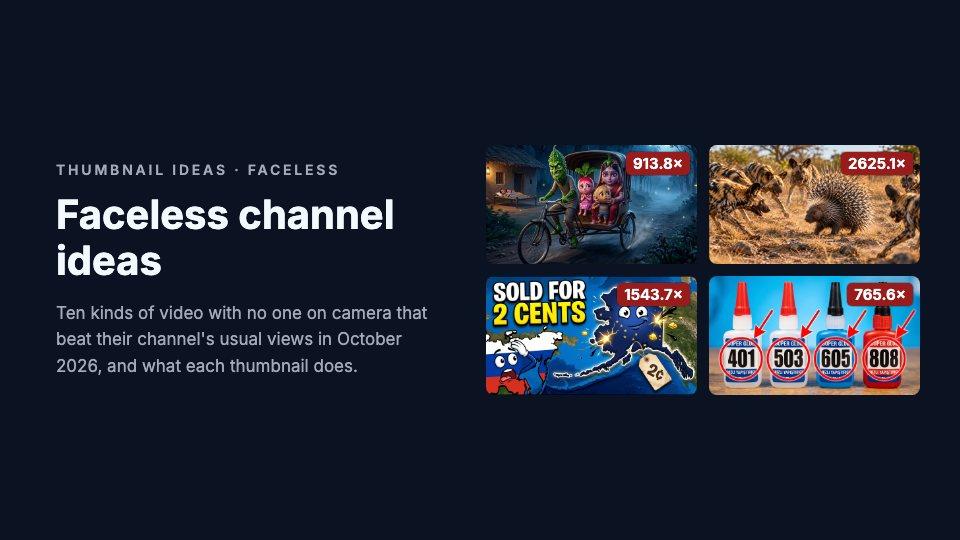
Here are ten kinds of faceless video that broke out this month:
- Vegetables with feelings. A potato family, a villain made of bitter gourd.
- Kindness that gets repaid. The waitress, the billionaire and the bill.
- Giant food in a small village. A golgappa the size of a house.
- A story told in clay. Tiny villages, big animals.
- A festival, 100 years ago. Diwali in 1926.
- Who wins in the wild. Wild dogs against a porcupine.
- A fantasy film, in episodes. Part 5 of a dragon saga.
- Stories for small children. The ant, the grasshopper and the snow.
- History, drawn simply. Alaska, sold for two cents.
- Hands only. Bricks, a bicycle wheel and super glue.
We checked each example against the three frames YouTube saves from the video, so every thumbnail below shows what its video is about.
Faceless doesn't mean no face
Most of the 20 thumbnails below still show a face: a potato's, a waitress's, a gorilla's, a cartoon Alaska's. None of them is the creator's.
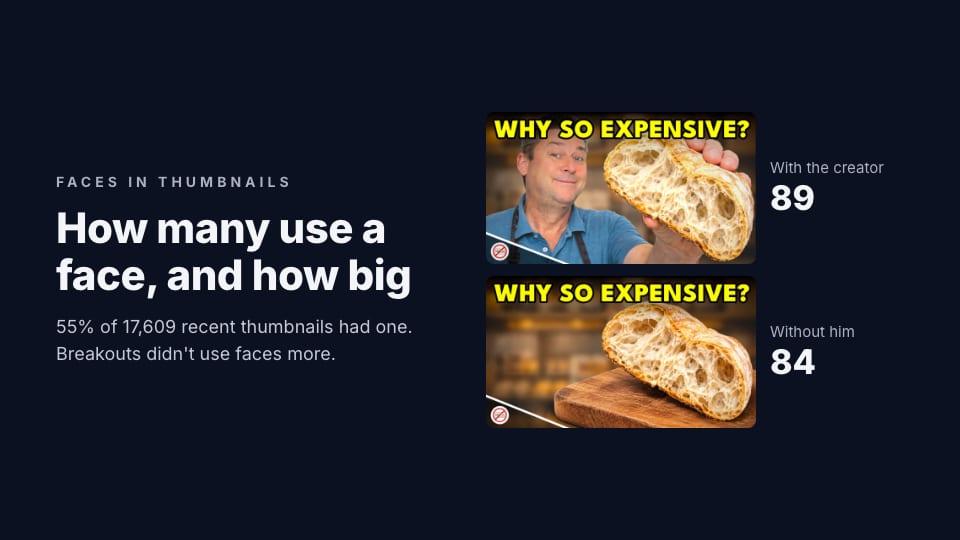
That fits what we found across 17,609 recent thumbnails: 55% had a face, from 29% in Pets & Animals to 81% in Comedy. A faceless channel can still give the viewer someone to look at. When it does, the face belongs to a character in the story.
1. Vegetables with feelings
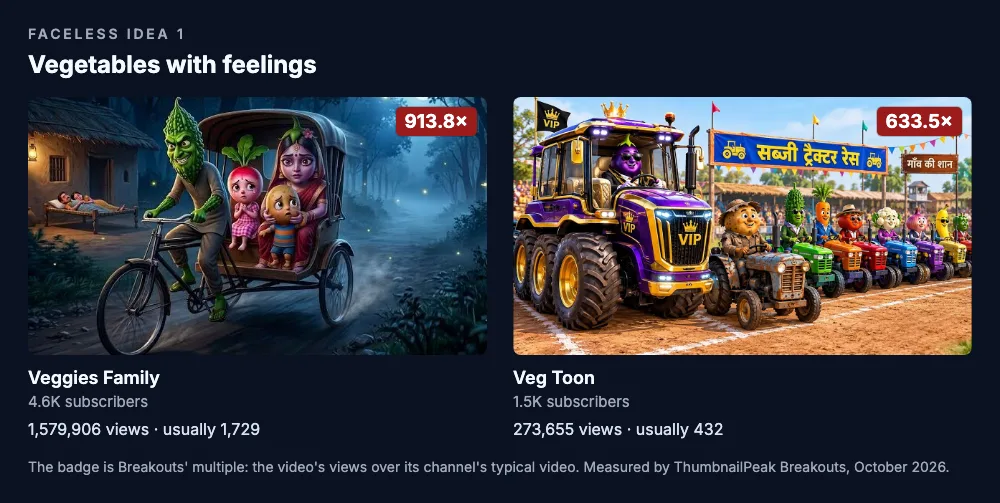
Talking-vegetable cartoons in Hindi were all over this month's grids. Veggies Family's six-minute "Children stolen in the dark of night! Can Potato save them?" (in Hindi) got 1,579,906 views, 914 times its usual. Its description calls it an "Ai cartoon". Veg Toon's "Potato Once Again Gave A Befitting Reply To Brinjal", tagged #aivideo and #nofacenovoice, got 273,655 views, 633 times its usual. Two more vegetable channels were in the top 30 of Film & Animation and Comedy.
The stories are old ones: a family in danger, a poor man against a rich one. What's new is that the characters are vegetables, which makes a familiar story look like something you haven't seen.
Both thumbnails put the whole conflict in one frame. On Veggies Family's, the villain is pedalling away with the children while the family sleeps. On Veg Toon's, the rich aubergine sits in a gold "VIP" tractor and the potato in a rusty grey one, side by side at the start line.
How to use it: show the threat and the victim together, or the rich one and the poor one together, at the moment before the story turns. Give each character one clear expression: a sneer, a frightened face, a smug grin.
2. Kindness that gets repaid
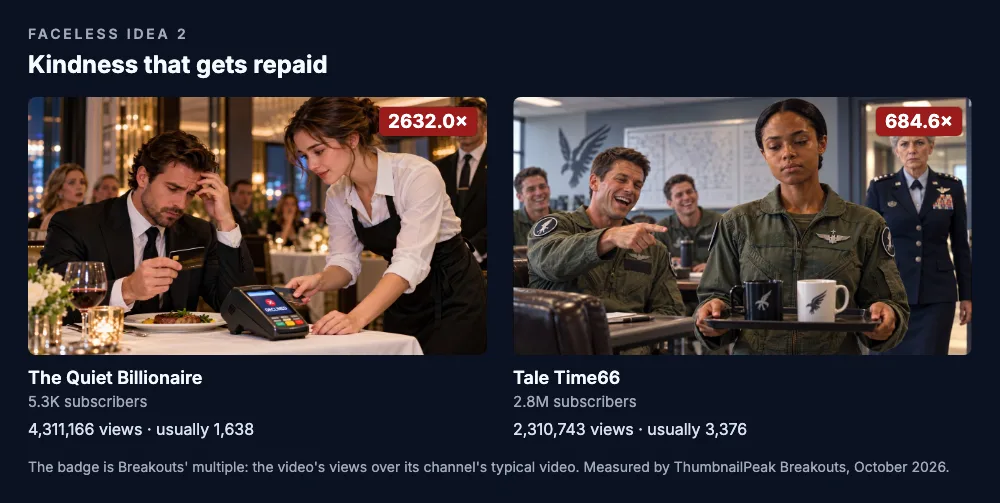
The Quiet Billionaire's story had the biggest multiple of the 20: 2,632 times its usual. A rich man pretends his card was declined to see how people treat someone without money. A waitress pays for his meal.
Tale Time66 told the same story in a different uniform. In "He Made a Fighter Pilot Serve Coffee—Then the General Walked In", a new pilot is made to serve coffee until someone senior arrives. Its description calls it "an AI-generated fictional aviation drama". It got 2,310,743 views, 685 times its usual.
Each thumbnail is the last second before the reveal. The waitress doesn't know who he is yet. The pilots laughing at her haven't seen the general yet. You click to see the moment they find out.
How to use it: freeze the scene just before the reveal, with the person who will be proved wrong in the frame. Put the hidden truth in the title, not on the picture, the way TaleForge Tv did: "Not Knowing He was the Billionaire CEO".
Be careful with this one. YouTube's monetization rules list "videos where characters are put in the same situation over and over again with the same outcome" among the content that can't earn money. That's this format, made the lazy way. If you tell these stories, make each one a different story.
3. Giant food in a small village
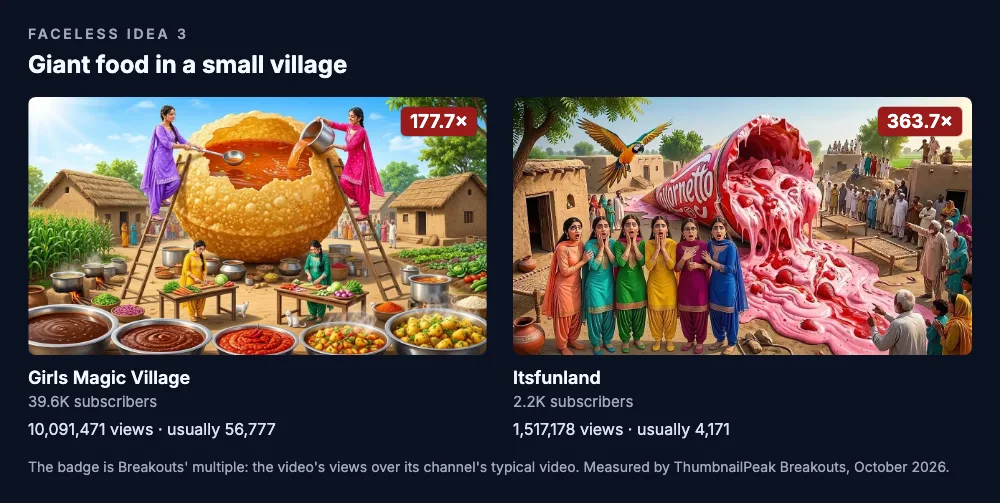
The biggest view count of the 20 belongs to Girls Magic Village's "4 Sisters Made a 70-Foot Giant Golgappa for the Village Festival!": 10,091,471 views. That's 178 times its usual, and its usual was already 56,777. The description says it plainly: the giant golgappa "and oversized cooking setup are imaginative elements created for the story".
Itsfunland made the same move with dessert. In "6 Sisters Found a GIANT Strawberry Cornetto Ice Cream!", a gigantic strawberry ice cream falls from the sky into a village. Its tags call it an "AI animation story". It got 1,517,178 views, 364 times its usual.
The thumbnail is one impossible thing in an ordinary place. Everyone knows how big a golgappa is, so a 70-foot one needs no explanation. The people standing beside it show the scale, and their faces show how to feel about it.
How to use it: pick a food everyone in your audience knows the size of, make it enormous, and put it somewhere ordinary. Show people beside it for scale. Keep the same characters, in the same clothes, from video to video.
Cosier versions of village life broke out too: Ghibli Aura's strawberry-farm treehouse and Cooking With Unknown's "Rainy Day in a 1990s Indian Village", sold as "No Talking ASMR".
4. A story told in clay
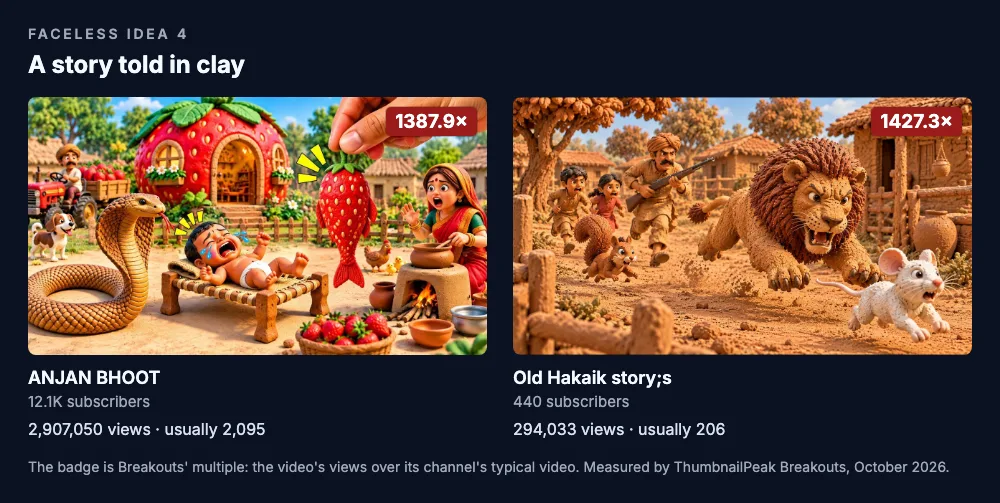
ANJAN BHOOT's "Cute Miniature Clay Strawberry House Making" got 2,907,050 views, 1,388 times its usual. Its description calls it "an adorable clay animation", in which a giant strawberry becomes "a beautiful miniature dream house".
Old Hakaik story;s had 440 subscribers when its "The Lion, Squirrel & Brave Mouse" got 294,033 views, 1,427 times its usual of 206. It's a four-minute fable in a clay village.
Clay looks handmade and harmless, so a scary moment looks safe. On ANJAN BHOOT's thumbnail, a cobra lies beside a sleeping baby, but it's a clay cobra. On Old Hakaik's, a lion is chasing a mouse, but it's a clay lion. Both thumbnails also show something small and precious about to be lost.
How to use it: take one fable or village story, tell it in a clay or toy-like style, and put the danger and the small hero in the same frame. A hand reaching in from the edge, like ANJAN BHOOT's, tells the viewer someone made all this.
5. A festival, 100 years ago
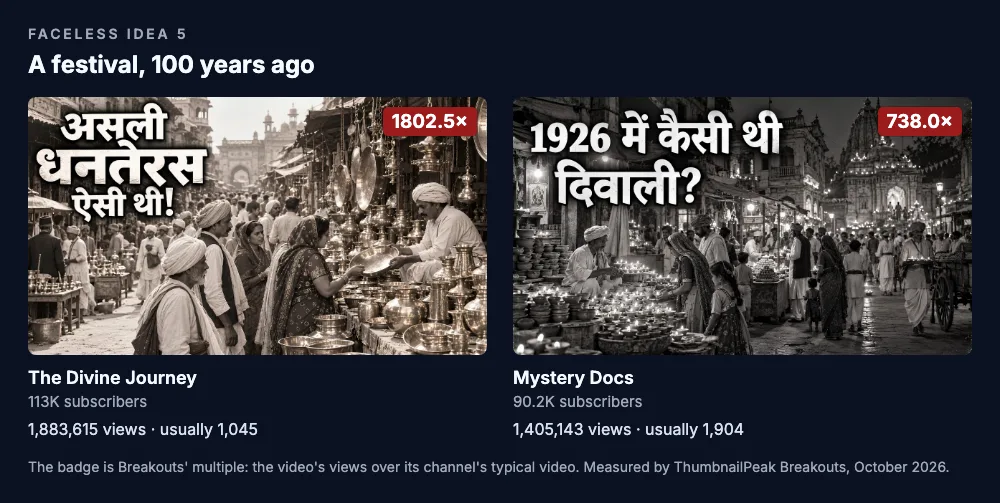
Two channels had the same idea within a week of each other, and both broke out. The Divine Journey's "What was Dhanteras like 100 years ago?" got 1,883,615 views, 1,803 times its usual. Mystery Docs' "What was Diwali like 100 years ago?" got 1,405,143, 738 times its usual. Both are in Hindi, and both came out three to four weeks before the festival: Dhanteras falls on 6 November this year, and Diwali on 8 November.
Each thumbnail looks like an old photograph: black and white, crowded, full of things that were ordinary in 1926. The words ask the question in one line, to viewers who are about to celebrate the same festival.
Inside, both videos are in colour, and the scenes are recreated. Mystery Docs' description calls its video "a cinematic cultural recreation" built on "historical imagination".
How to use it: take a day your audience is about to celebrate and show it 100 years ago. Publish it a few weeks before the day, while people are starting to plan, and make the thumbnail look like the past. YouTube requires you to disclose AI content that "generates a realistic scene that didn't actually occur", and a realistic 1926 street is that. Answer yes to YouTube's altered content question when you upload, and say it's a recreation in the description, as Mystery Docs does.
6. Who wins in the wild
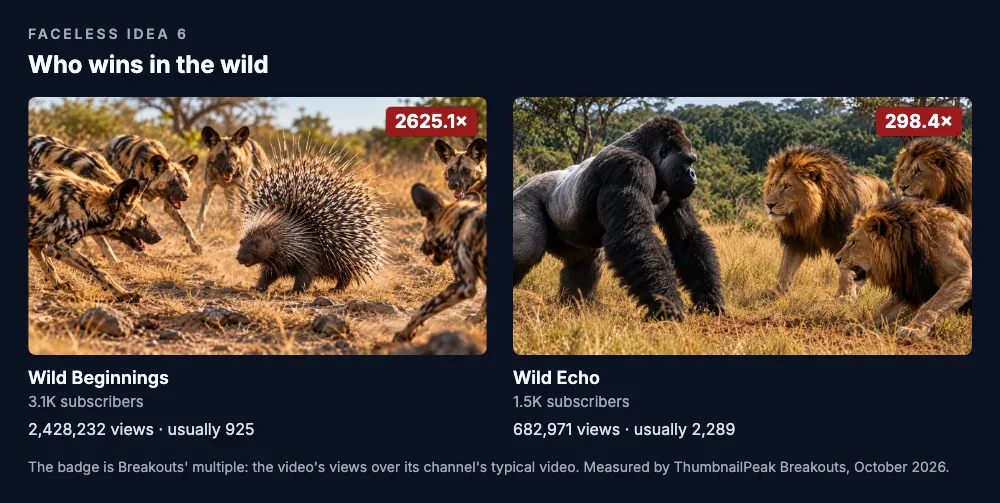
Wild Beginnings' "Wild Dogs Surround a Porcupine" got 2,428,232 views, 2,625 times its usual. Its description calls it "a biologically grounded wildlife story". Wild Echo's "Three Lions Attacked the Wrong Gorilla" got 682,971 views, 298 times its usual, and its description says the video "was created with AI".
The thumbnail asks one question: who wins? Many against one, and the one has a weapon you can see: a coat of quills, a silverback's size. The titles hint at the answer ("the wrong gorilla") without giving it away.
How to use it: put both sides in the frame, close enough that the fight is about to start, with the underdog's advantage obvious. Real footage of a real encounter is the honest version of this idea. If yours is AI-made and looks real, YouTube requires the disclosure.
7. A fantasy film, in episodes
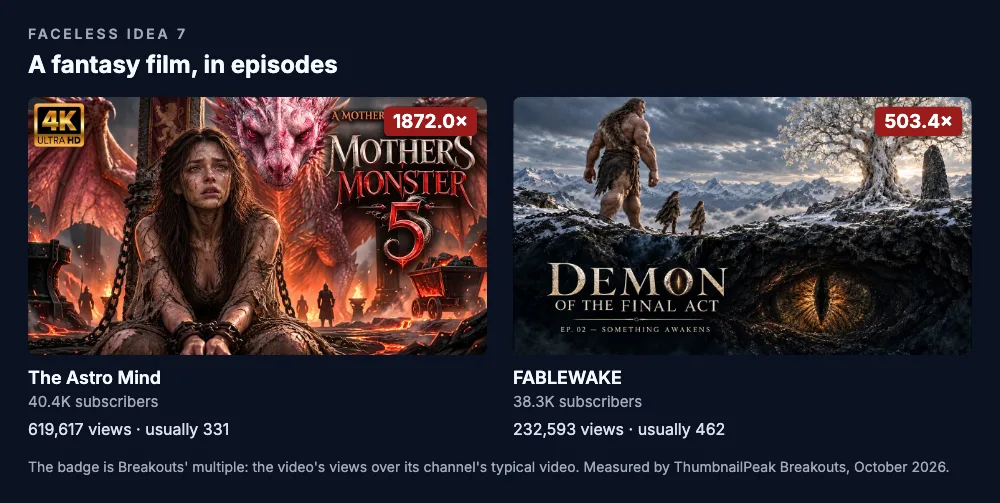
Long fantasy films are breaking out too. The Astro Mind's "A Mother Chained In Fire | The Mother's Monster 5" runs 47 minutes and got 619,617 views, 1,872 times its usual. FABLEWAKE's "Demon of the Final Act, Ep. 02" runs 29 minutes, and its description calls it "an original AI-created dark fantasy film". It got 232,593 views, 503 times its usual, though that usual comes from only three earlier videos.
Both thumbnails look like film posters, and both carry a number: "5" and "EP. 02". The number tells a new viewer there's a story to catch up on, and tells a returning one this is the next part.
How to use it: make the thumbnail a poster, with the title lettered into it and the episode number big enough to read on a phone. Show the one image the episode is about: the chains, the eye under the mountain. Fantasy is the easy case for disclosure: YouTube's own example of AI content that needs no label is "someone riding a unicorn through a fantastical world".
8. Stories for small children
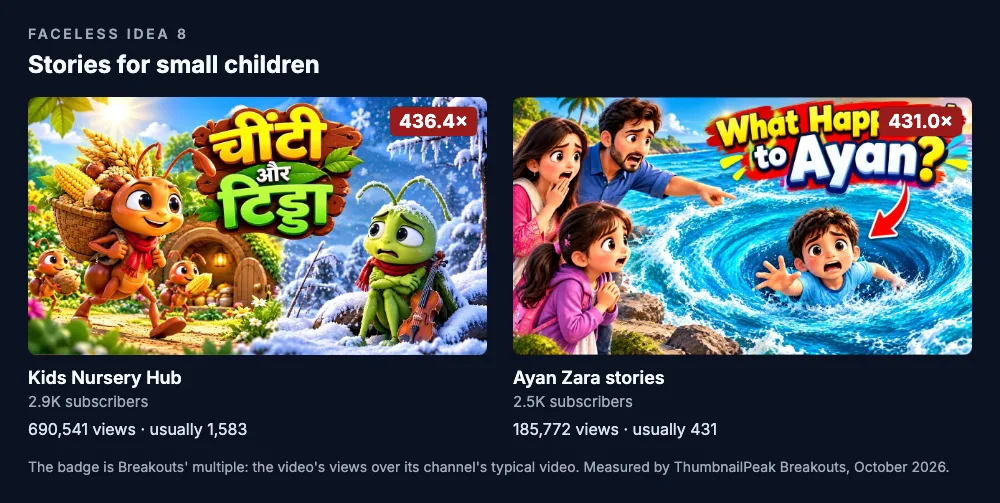
Kids Nursery Hub's "The Ant and the Grasshopper | Bedtime Story for Kids In Hindi" got 690,541 views, 436 times its usual. The fable is centuries old. The thumbnail shows its ending at a glance: the ant who worked all summer is warm, and the grasshopper who played is out in the snow.
Ayan Zara stories' "What Happened to Ayan | Lost in a Dangerous Ocean" is labelled "Slow English Story for Kids". Its description says it's for "children and English learners". It got 185,772 views, 431 times its usual.
A children's video has two people to win over: the child who wants it, and the parent who decides. The Ant and the Grasshopper is a story the parent already trusts. "What Happened to Ayan?" is a question the child wants answered.
How to use it: retell a fable parents already know, and show its lesson as two halves of one picture. Or name a child character in a question. Say who it's for in the title: "Bedtime Story", "Slow English".
9. History, drawn simply
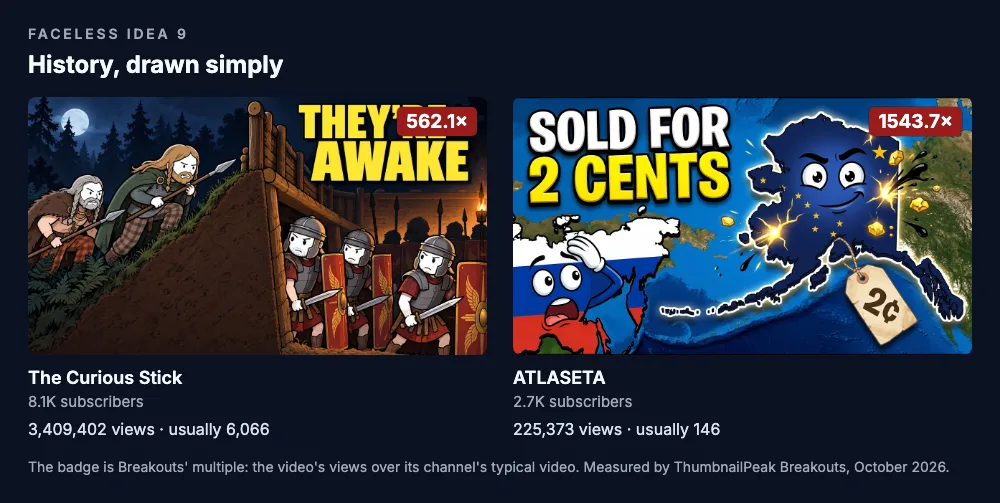
The Curious Stick's "Why Attacking a Sleeping Roman Army Was a Death Trap" got 3,409,402 views, 562 times its usual. It tells a real battle from AD 15 with stick-like drawings. Its description begins "(Completely Human Voiceover)". On a faceless channel, the voice is the part of you the viewer meets.
ATLASETA's "The Worst Deal in History? The Full Story of Alaska" got 225,373 views, 1,544 times its usual of 146. Its animated maps turn countries into characters.
Both thumbnails take one fact and make it a joke you get in a second. Alaska is wearing a "2¢" price tag. The attackers have climbed the wall, and the Romans were waiting for them: "THEY'RE AWAKE".
How to use it: find the one surprising fact in your history story, draw it as simply as you can, and put it in four words or fewer. A price, a date or a twist. The drawings can be basic if the fact is strong.
10. Hands only
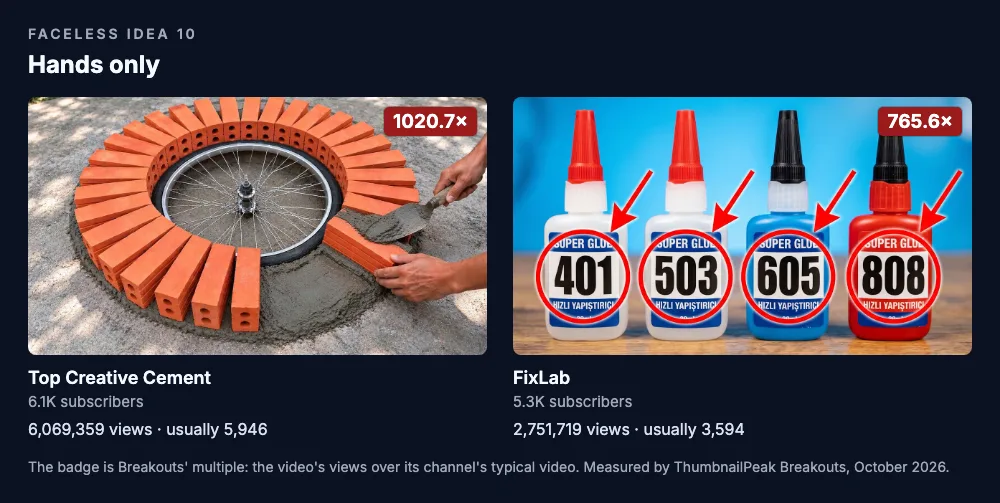
The plainest faceless format of all is still breaking out. Top Creative Cement's "Crazy Idea from a 65-Year-Old Mason — Bricks Around a Bicycle Wheel Create an Amazing Masterpiece!" got 6,069,359 views, 1,021 times its usual. The video is two hands building a brick fire pit. FixLab's "What Do the Numbers on Super Glue Actually Mean?" got 2,751,719 views, 766 times its usual: hands testing glues on glass and wood.
Neither needs AI or a face. The thumbnails work because each shows an object people own, used in a way they hadn't thought of: a bicycle wheel as a mould, the small print on a glue bottle as the answer to a question.
How to use it: photograph the one strange combination (bricks and a bicycle wheel) or circle the detail people never read (the number on the bottle). Keep the hands in the frame, so it's clear a person is doing it and the viewer could too.
Is this "YouTube automation"?
People use "YouTube automation" for running a channel you don't appear in, with writers, voice artists, editors or AI tools doing the work. From the outside, we can't tell which of the channels above work that way. YouTube's rules don't forbid it, but three of them matter.
- AI is allowed. YouTube asks you to label some AI content, not to avoid it.
- Realistic AI has to be disclosed. YouTube requires a label on AI content that "makes a real person appear to say or do something they didn't do", "alters footage of a real event or place" or "generates a realistic scene that didn't actually occur". Its examples of what needs no label include animation and "someone riding a unicorn through a fantastical world". You answer one question when you upload; the details are in YouTube's help page on disclosure.
- Mass production can't earn money. Since 15 July 2025, YouTube calls this "inauthentic content". Its monetization policies list "AI-generated content made with generic or unoriginal templates giving the impression of mass production without adding the creator's original, authentic insights or perspective".
Leave out stories about real people. Some of this month's biggest faceless breakouts told dramatized stories about famous people, with pictures that look real. Making a real person appear to do something they didn't is the first thing on YouTube's disclosure list, and it puts words in the mouth of someone who never said them.
What the numbers don't show
The median "usual" of the 20 channels above is about 1,700 views a video, and seven of them usually get under 1,000. A breakout is the one video that went far past that. What these numbers can't show is how many videos those channels made that didn't. A channel that posts every day can have a breakout and a hundred videos nobody watched.
So treat these as ideas that are working right now, not as a recipe. The ten formats are easy to copy, which is why most of them already have several channels making them. What made each breakout different was the particular story: a 70-foot golgappa, Diwali in 1926, Alaska for two cents.
Making the thumbnail when there's no one to photograph
A faceless channel still needs a thumbnail for every video, and often there's nothing to photograph. AI-made thumbnails aren't only for AI-made videos: several in this month's Science & Tech grid looked AI-made, on videos that were filmed for real. YouTube's disclosure page lists "Production assistance, like using generative AI tools to create or improve a video outline, script, thumbnail, title, or infographic" among the uses that need no label.
ThumbnailPeak's AI thumbnail maker starts from the video. Paste a link, or describe a video you haven't uploaded yet in a paragraph, and it designs a thumbnail from that, then scores it. A thumbnail costs 3 credits, and a free account comes with 12. This guide shows what it made for six videos that were never filmed. Then put the thumbnail in a real YouTube feed with the free thumbnail tester, beside the videos it will compete with.
Find next month's faceless breakouts
These 20 will be replaced by new ones within weeks. Open the Categories tab on Breakouts. It's free and doesn't need an account. This month, faceless breakouts were easiest to find in Film & Animation, Entertainment, People & Blogs, Howto & Style, Pets & Animals and Education. Each category is swept once a week and keeps about a month of videos, biggest breakout first.
The filters help: 100×+ for the biggest jumps, your channel size, and a Language filter for titles in the alphabet you read. Every card has a Critique this thumbnail button that sends it for an AI critique, which says what's doing the work in the thumbnail and what isn't.
Key takeaways
- Faceless breakouts are everywhere. At least 40 of the 360 biggest breakouts this month were made with AI pictures from start to finish, in 10 of the 12 categories, and plenty more used drawings, maps or hands.
- Faceless doesn't mean no face. Most of these thumbnails show a character's face, just not the creator's.
- Freeze the moment before the turn. The waitress who doesn't know yet, the wild dogs about to close in.
- Make the ordinary impossible. A golgappa the size of a house, Alaska with a 2¢ tag.
- Follow YouTube's rules. Label realistic AI scenes, leave out stories about real people, and make each video a different story.
How we picked these: on 25 October 2026 we took each of the 12 Breakouts category grids, and read the 30 biggest breakouts with at least 30,000 views, one per channel: 360 videos, published 3 to 20 October. The examples were published 6 to 19 October. Each video's "usual" is the median views of its channel's 10 most recent uploads that were at least two weeks old, or as many as a young channel has, down to three, and the badge is its views divided by that. We counted a video as made with AI pictures from start to finish only when all three frames YouTube saves from inside it were AI-made images; we can't tell a voice from a still, so the count leaves out videos with real pictures and an AI voice, and one we weren't sure of counts as not AI. We call a channel's video AI-made in this post only where its own title, description or tags say so. View counts are Breakouts' October 2026 measurements and keep changing. Thumbnails and channel names belong to their creators and are shown for commentary and education.