Disclosure: we make ThumbnailPeak, and these videos come from its free Breakouts tool. The thumbnails belong to their creators, who had nothing to do with this post, and are shown here for commentary.
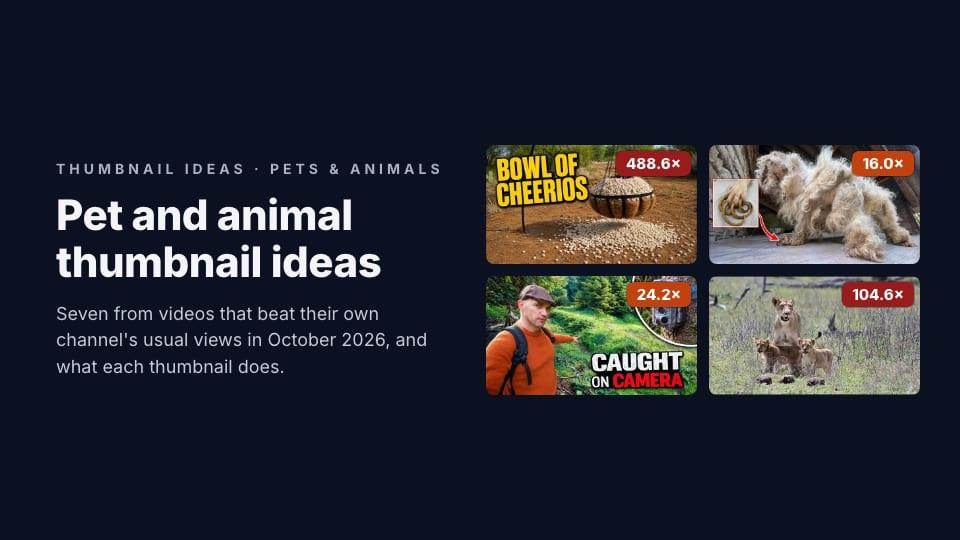
The Cactus Country is a channel with 851 subscribers. Its videos usually get about 180 views. In October it hung a basket of Cheerios on a stand in the West Texas desert, pointed a trail camera at it, and posted what turned up. The video got 89,907 views, 489 times its usual. The thumbnail doesn't show a single animal. It shows the Cheerios.
That's a breakout: a video that does far better than its own channel normally does. With so few subscribers, nearly all of those views came from people who had never seen the channel before.
On 22 October 2026, the Pets & Animals grid in ThumbnailPeak's Breakouts held 814 videos published between 3 and 17 October that beat their channel's typical video. 348 did it by three times or more. We read the 60 biggest with at least 30,000 views, one per channel, and picked seven ideas for pet, wildlife and nature channels:
- Show the bait, not the animal. The setup is the question; the animal is the answer.
- You, and the camera that caught it. A person, a pointing arm and the camera.
- The before, with one detail up close. For rescues and grooming.
- A line-up of faces. For breed lists and rankings.
- The milestone in two words. "FIRST FISH!"
- The small build, and what it started as. A jar, an arrow, a pond.
- The moment itself, no words. When the footage is the hook.
A note on what we left out
Many of the biggest multiples in this category, at least 15 of the 60 by our count, came from story channels whose thumbnails look like painted scenes: animals fighting in perfect light, a puppy hugging a stranger, monkeys cooking. We left those out. They're a different kind of channel, and from the outside we couldn't tell what their videos actually show.
Every example below was checked against the frames YouTube saves from the video, so each thumbnail shows something the video really has. If you film real animals, these are the ideas that fit you. And if you're tempted by a thumbnail of a moment your camera never caught, our post on clickbait thumbnails explains why viewers who don't find it leave.
What pet and animal thumbnails usually look like
They're the least wordy thumbnails on YouTube. In our study of 17,609 recent thumbnails, only 49% of Pets & Animals thumbnails had a headline, the lowest of the nine categories we measured. Half had no headline at all, against about a quarter across all nine. They also had the fewest human faces, 29%. The animal is the star.
The 60 biggest animal breakouts went further. 36 of the 60 had no headline at all, 11 had a human face, and only 5 had a number in big letters. So the first idea isn't really an idea: a good animal picture, big and sharp, does most of the work. The seven below are for when you need a little more.
1. Show the bait, not the animal
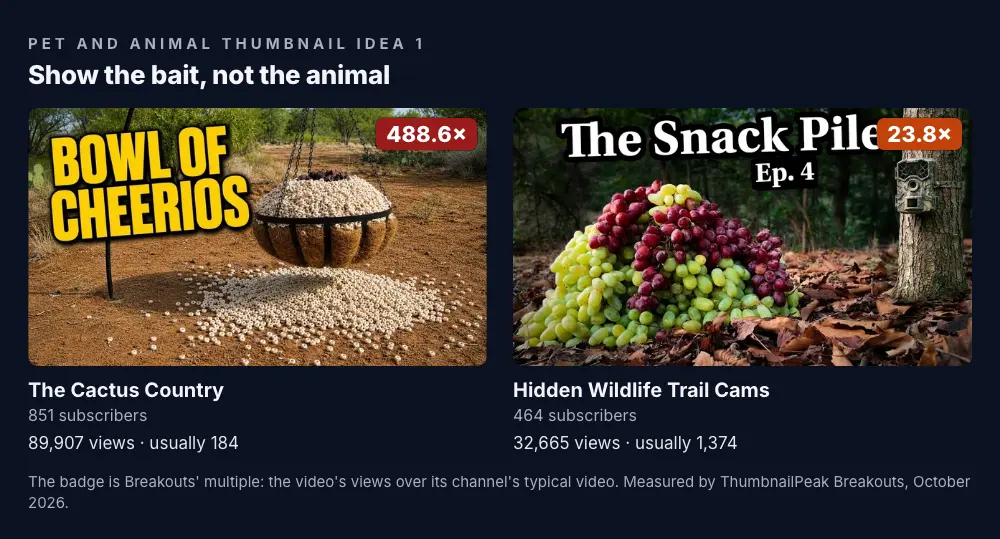
The Cactus Country's "We Left a LARGE BOWL of CHEERIOS in West Texas Desert. Here's what happened!" shows the bowl, not the deer that came to eat from it. Hidden Wildlife Trail Cams did the same with a heap of grapes in a forest in "We Left a HUGE PILE of Grapes Deep in the Woods... Here's What Showed Up.", and calls it a series: "The Snack Pile Ep. 4".
It works because the question is "what came?", and showing the answer would end it. A pile of food in an empty place is strange enough to stop a scroll, and you can only find out what ate it by watching.
How to use it: for trail-camera videos, put the bait in the thumbnail, big and slightly absurd, and keep the animals for the video. If it's a series, number it. Viewers who liked one episode look for the next.
2. You, and the camera that caught it
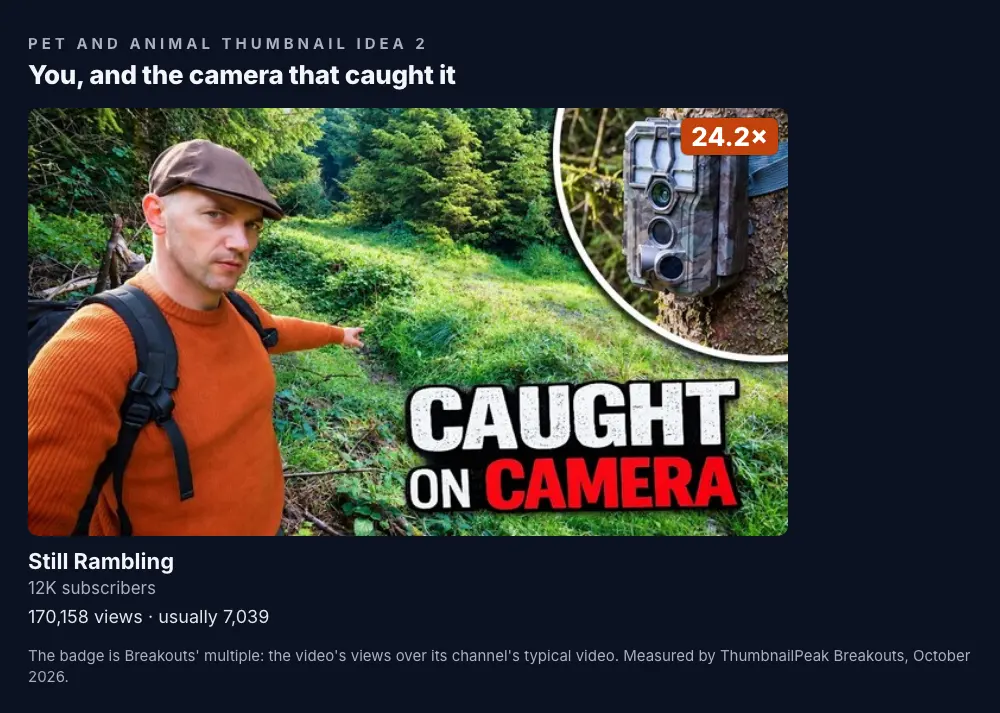
Still Rambling's "The Worst Thing I've Ever Caught on Camera…" puts three things in one frame: the creator pointing down a path, the trail camera in a circle, and "CAUGHT ON CAMERA". It got 170,158 views, 24 times the channel's usual. The person makes it a story about someone, the camera makes it real, and the pointing arm says "it was there".
Notice what's missing: the animal. The title says it's the worst thing the camera ever caught, and the thumbnail keeps it hidden. Like the bait in idea 1, it leaves the answer for the video.
How to use it: if what your camera caught is ordinary on its own, show yourself, the camera and the spot, and let the title raise the stakes. If what you caught is extraordinary, skip ahead to idea 7 and show it.
3. The before, with one detail up close
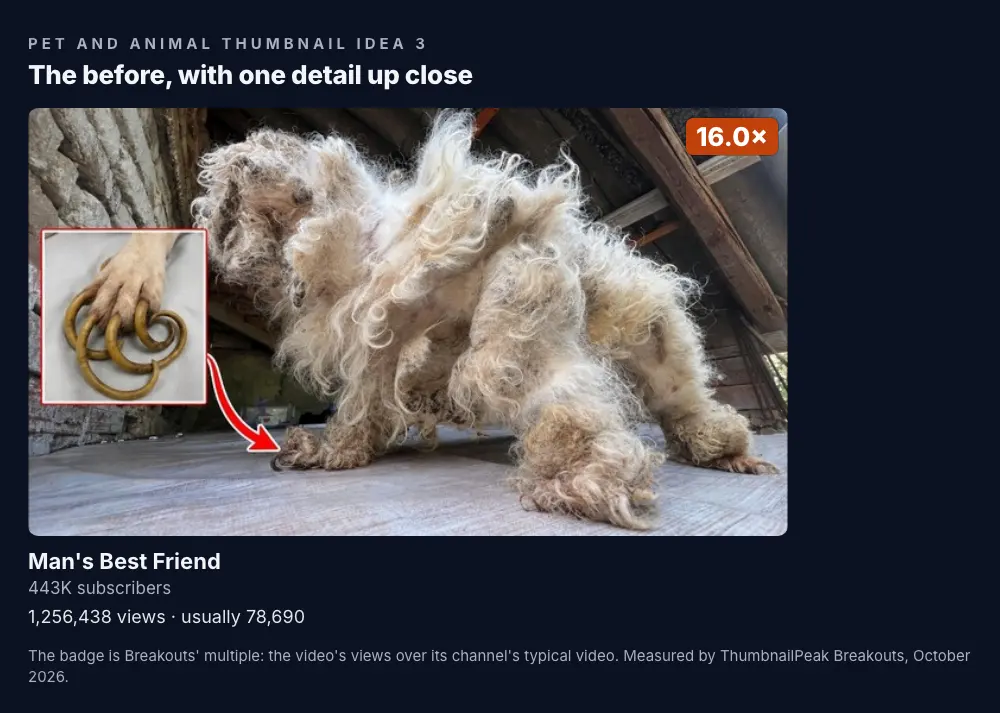
Man's Best Friend is a big grooming and rescue channel, and its "What Happened After We Removed the Fur Made Me Cry" still did 16 times its usual: 1,256,438 views. The thumbnail is the dog at its worst, a heap of matted fur. A small inset shows its nails, grown into curls, and a red arrow points from the inset to its paw.
The inset does something the main picture can't. At phone size, matted fur is just a shape. The curled nails, enlarged, make you understand how long this dog has been left.
How to use it: for rescues, grooming and vet videos, show the before, never the after, and add one enlarged detail that makes the problem obvious. Keep it true: the detail should be from the animal in the video.
4. A line-up of faces
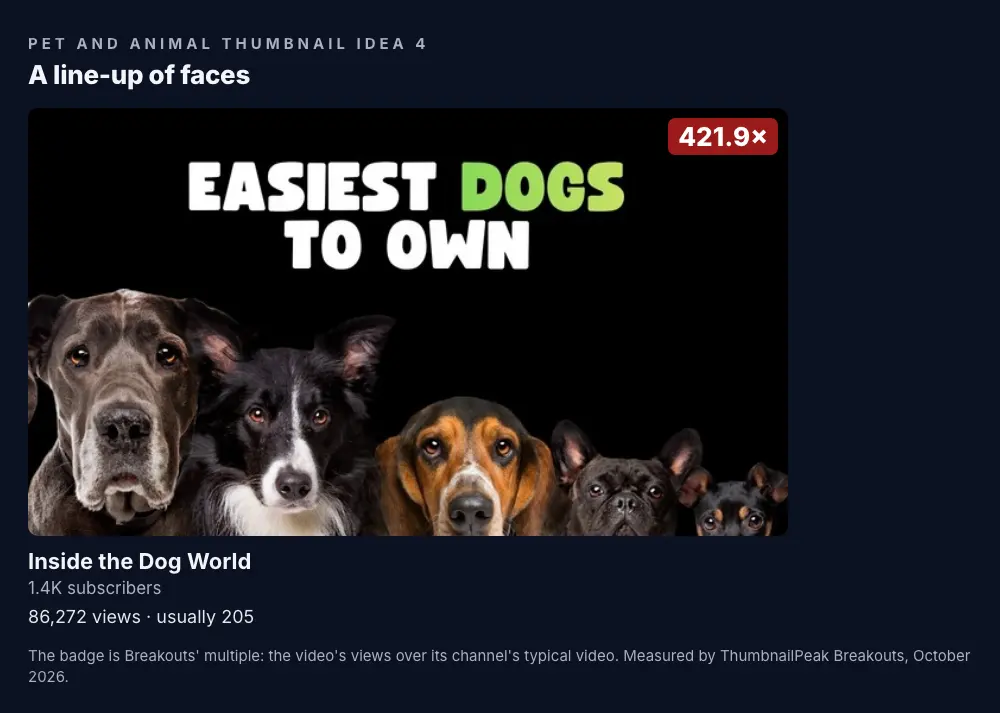
Inside the Dog World's "20 Low-Maintenance Dog Breeds, Ranked from Easy to Effortless" got 86,272 views, 422 times its usual. The thumbnail is a row of dog faces looking up from the bottom of a black frame, under "EASIEST DOGS TO OWN". Every dog owner looks for their breed.
The black background makes each face readable at a small size, and the faces all look at you.
How to use it: for breed lists and rankings, show a row of faces, different shapes and sizes, on a plain background. Leave the order for the video.
5. The milestone in two words
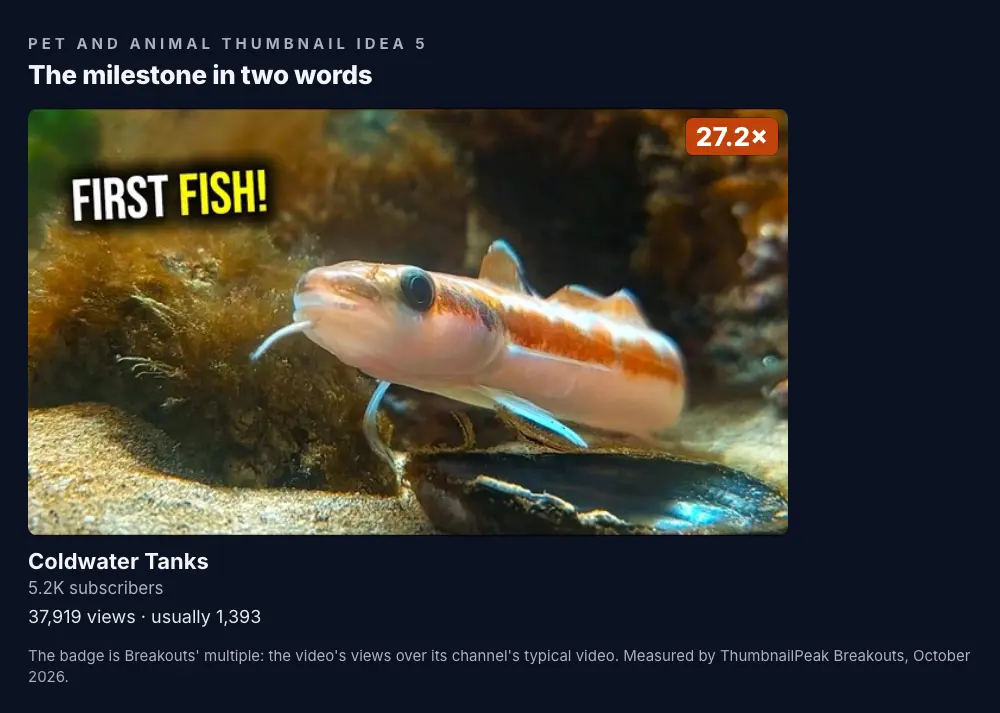
Coldwater Tanks had been building a 1,000-litre tank. "The 1000L Coldwater Tank Finally Has Fish" got 27 times the channel's usual. The thumbnail is one fish, close up and sharp, and two words: "FIRST FISH!".
For a channel that documents a project, the milestone is the event. Regular viewers have waited for it, and new viewers can see that something has finally happened.
How to use it: when a long project hits a milestone, like a first fish, a first egg or a first walk, show that one thing close up and name the milestone in two or three words.
6. The small build, and what it started as
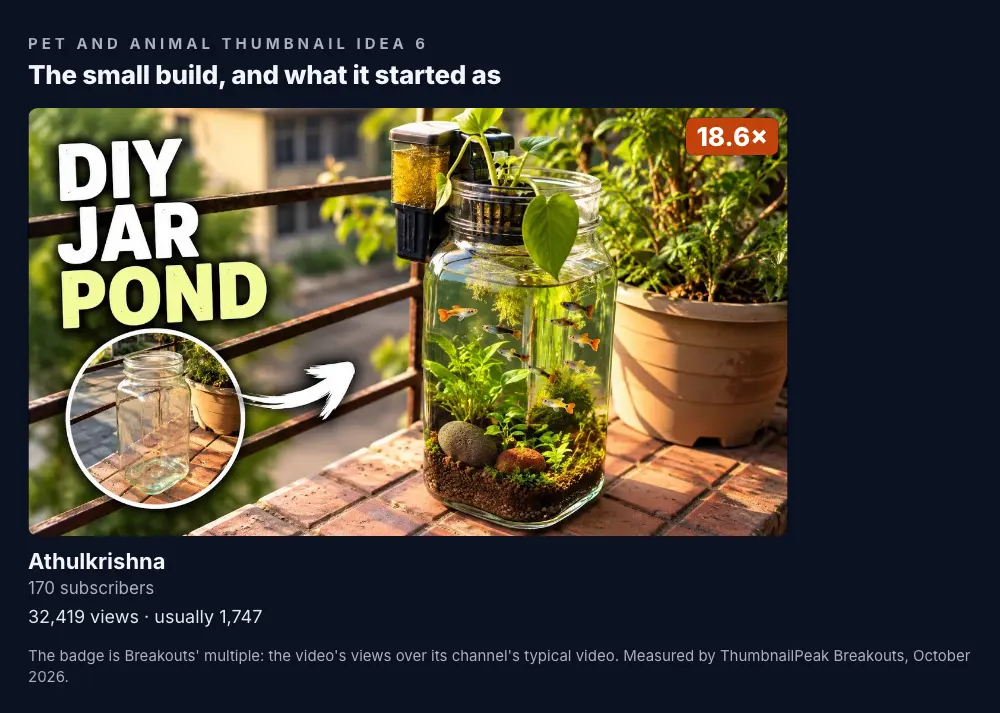
Athulkrishna's "DIY Mini Pond for Tiny Fish in a Glass Jar" shows the finished pond, planted and full of fish, with a small circle of the empty jar it started as and an arrow from one to the other. "DIY JAR POND" says what it is.
The empty jar is what makes it work. It tells you this is something you could make too, from something you already have.
How to use it: for builds, like enclosures, tanks, feeders and toys, show the finished thing big, and the humble starting material small, with an arrow.
7. The moment itself, no words
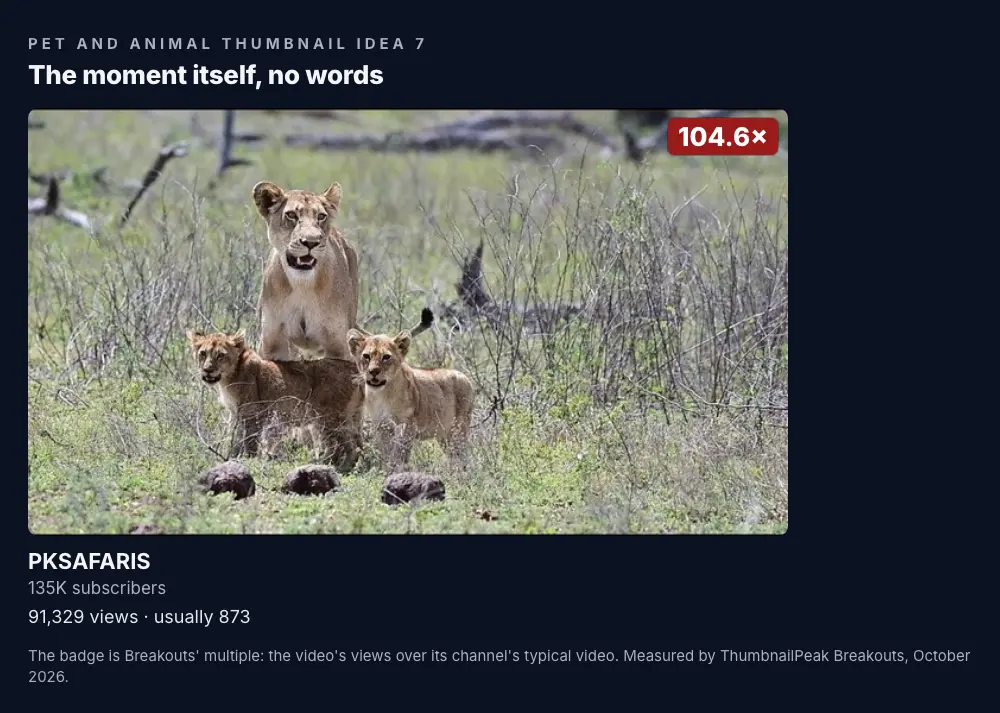
PKSAFARIS films sightings in Kruger National Park. "She was looking for them... What a lion pride sighting" got 91,329 views, 105 times the channel's usual. The thumbnail is a frame from the footage: a lioness and two cubs, all looking toward the camera. No words, no arrows.
That's the most common animal breakout thumbnail of all, and it needs only one thing: a moment worth stopping for, framed so the animals' faces are big enough to see.
How to use it: if you caught a real moment, use the best frame, crop in until the animal fills the picture, and let the title tell the story.
What a thumbnail can't do
These thumbnails didn't make their videos break out on their own. Across 3,523 channels, we found breakouts looked just like their channel's ordinary thumbnails: the same words, the same faces, the same colours. It's in what a thumbnail can and can't do.
What set these videos apart was the idea, or the luck: Cheerios in the desert, two rare leopards, a lioness and her cubs. The thumbnail's job is to show that at a glance. And borrow the idea, not the image. A copy of someone's thumbnail competes with the original for the same click.
Find this month's animal breakouts
Open the Categories tab on Breakouts and pick Pets & Animals. It's free and needs no account. Each category is swept once a week and keeps about a month of videos, biggest breakout first.
Expect to see the story channels we left out. The filters help: set your channel size, 10×+ and the last 30 days, and use the Language filter to keep titles you can read. To look up one kind of video, like "trail camera" or "dog grooming", the Search tab measures YouTube's top results for it. That needs a free account, which comes with 12 credits; a search uses 1.
Each card's Critique this thumbnail button sends it for an AI critique, which explains what's doing the work. When yours is ready, put it in a real YouTube feed with the free thumbnail tester to see how it looks next to the videos it will compete with.
Key takeaways
- Animal thumbnails need the fewest words. Half had none, and 36 of the 60 biggest animal breakouts had no headline.
- Show the setup, keep the payoff. A pile of bait, not the animal that ate it.
- One detail, enlarged. For rescues, an inset of the worst detail says more than the whole animal.
- A real moment beats a painted one. Many of the biggest multiples were illustrated story channels. If you film real animals, show what you filmed.
- Borrow the idea, not the image.
How we picked these: the videos come from the Pets & Animals grid in ThumbnailPeak's Breakouts on 22 October 2026, published 3 to 17 October. Each video's "usual" is the median views of its channel's 10 most recent uploads that were at least two weeks old, or as many as a young channel has, down to three, and the badge is its views divided by that. We read the 60 biggest breakouts with at least 30,000 views, one per channel, and checked each example against the three frames YouTube saves from the video. Faces and headline words were counted with Apple's Vision framework on our own computer, as in our posts on faces and text. View counts are Breakouts' measurement on 19 October 2026 and keep changing. Thumbnails and channel names belong to their creators and are shown for commentary and education.