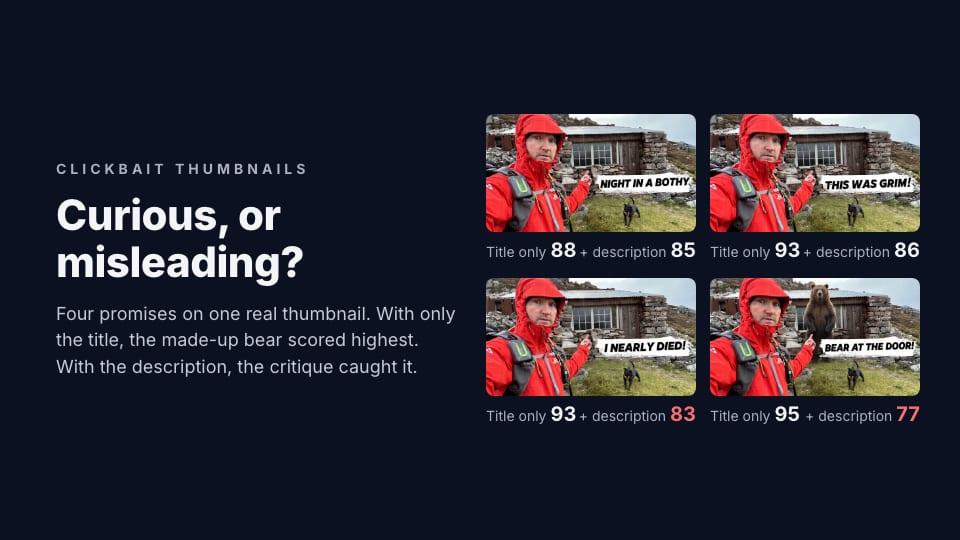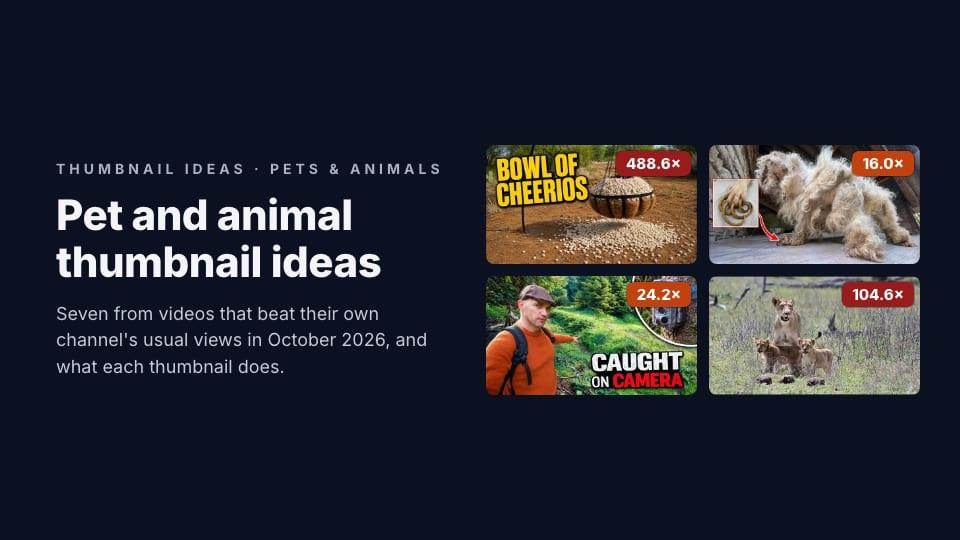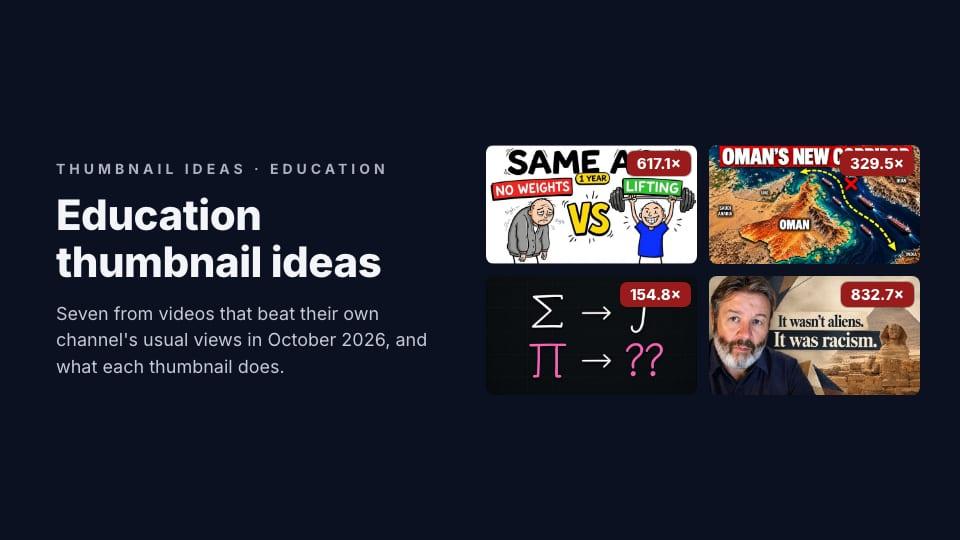
Disclosure: we make ThumbnailPeak, and these videos come from its free Breakouts tool. The thumbnails belong to their creators, who had nothing to do with this post, and are shown here for commentary.
Sohil Rathi makes maths videos. In October he posted "The Missing Calculus Operation", and its thumbnail has no picture at all, just four symbols on a dark grid: Σ → ∫, and below it, Π → ??. It got 367,456 views, about 155 times what his videos usually get.
That's a breakout: a video that does far better than its own channel normally does. A jump that size can't come from subscribers. The idea, and the way the thumbnail put it, had to reach people who had never heard of the channel.
On 22 October 2026, the Education grid in ThumbnailPeak's Breakouts held 1,359 videos published between 5 and 19 October that beat their channel's typical video. 735 did it by three times or more, the most of any category. We read the 60 biggest with at least 30,000 views, one per channel, and picked seven ideas for history, science, maths and explainer channels:
- Two versions of the same person. The choice, and where it leads.
- Then, an arrow, now. How a thing became what it is.
- One route on a map. For geography and current events.
- Symbols with a gap. For maths and science.
- Draw it simply. Cartoons explain what photos can't.
- One calm sentence. A claim stated flatly.
- A number about one person. A result with a question mark.
We checked each example against the frames YouTube saves from the video, so every thumbnail below shows what the video covers.
What educational thumbnails usually look like
Education sits near the middle on faces and near the top on words. In our study of 17,609 recent thumbnails, 59% of Education thumbnails had a face and 84% had a headline, behind only Sports.
Among the 60 biggest education breakouts, 34 had a face, 14 had no headline, 17 put a number in big letters, and 12 asked a question, the most of any category we read. That fits: an educational video promises an answer, so its thumbnail often asks the question.
1. Two versions of the same person
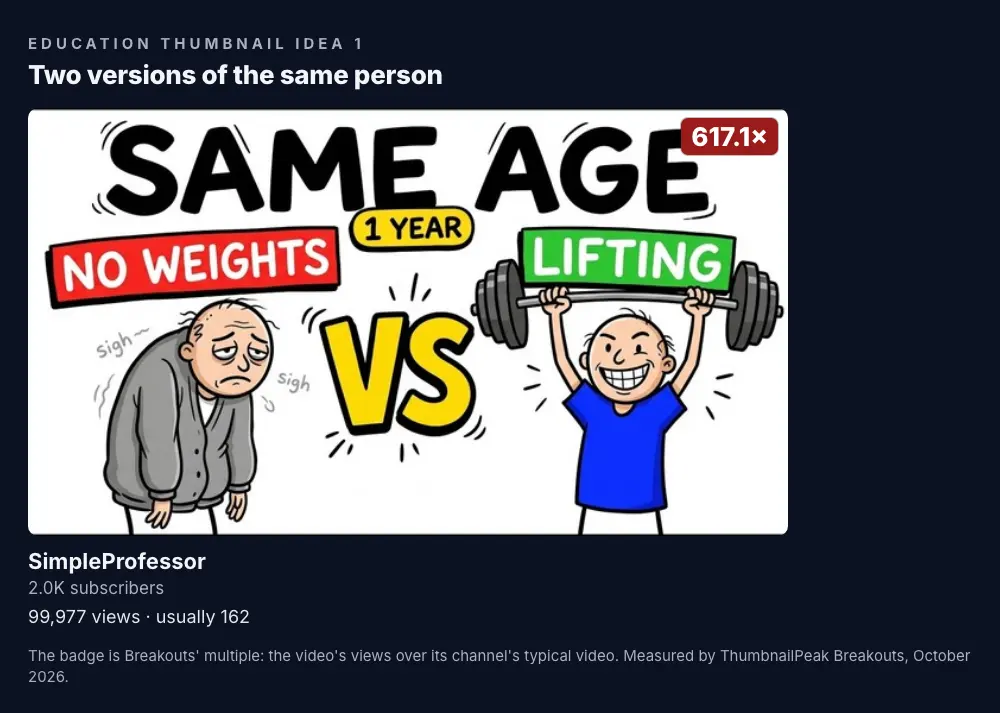
SimpleProfessor's "A Year of Strength Training After 50: What Actually Changes" got 99,977 views on a channel whose videos usually get 162. That's 617 times its usual. The thumbnail is a cartoon of the same man twice. "SAME AGE", "1 YEAR", one hunched over under "NO WEIGHTS" and one grinning with a barbell under "LIFTING".
It shows the result of a choice before the viewer has made it. The viewer is the man on the left, and the thumbnail shows him the man on the right.
How to use it: for health, habits and skills, draw the same person twice, after two different choices. Label each side, and keep the drawing simple enough to read at phone size.
2. Then, an arrow, now
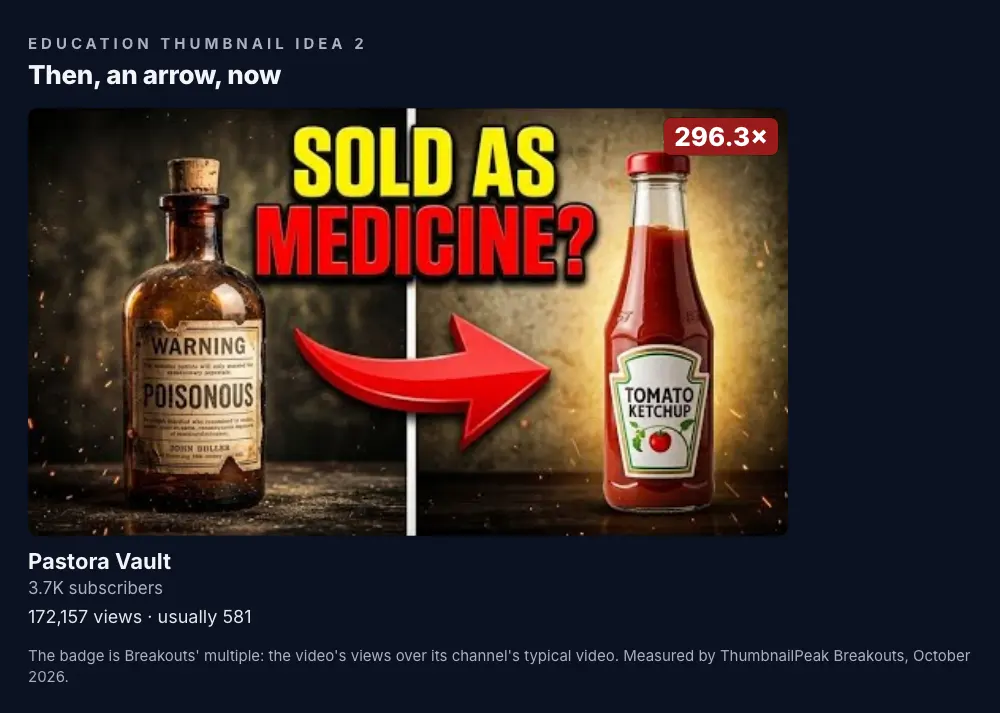
Pastora Vault's "The Sauce That Was Once Sold as Medicine | The Strange History of Ketchup" puts an old medicine bottle marked "POISONOUS" on the left, a ketchup bottle on the right, and an arrow between them. "SOLD AS MEDICINE?" asks the question. It got 172,157 views, 296 times its usual.
Everyone knows ketchup. Nobody expects it to come from a poison bottle. The gap between the two objects is the whole history lesson, compressed into an arrow.
How to use it: for "the history of X" videos, put the surprising origin on the left and the familiar thing on the right, with an arrow. The more ordinary the thing on the right, the better.
3. One route on a map
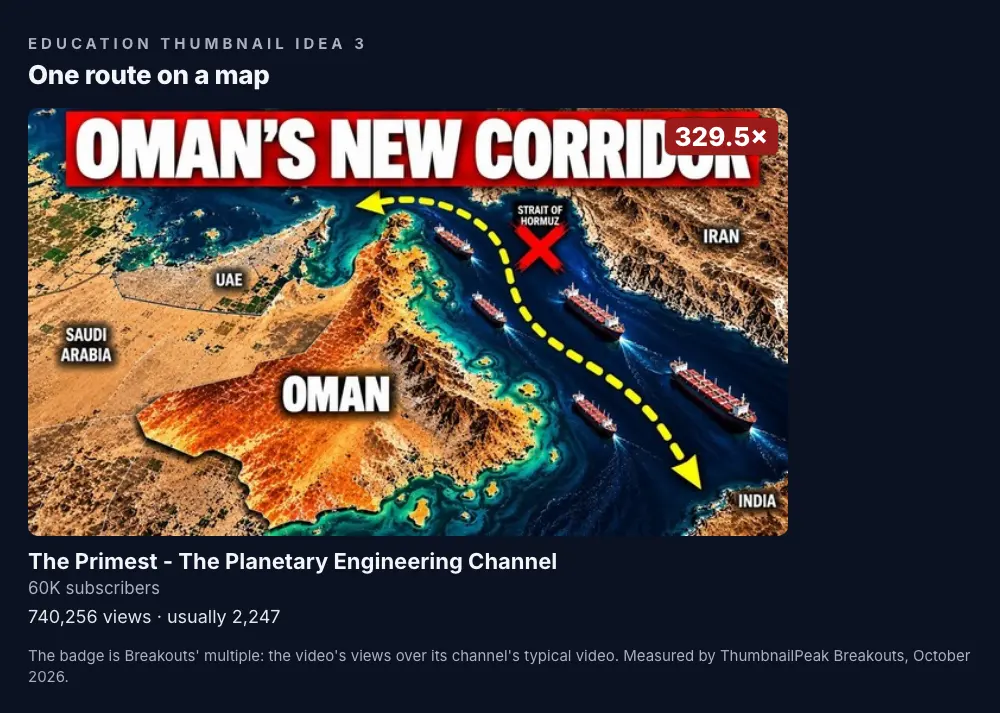
The Primest's "Oman has Built a New Route to Bypass the Strait of Hormuz" got 740,256 views, 330 times its usual. The thumbnail is a map with one thing drawn on it: a red X on the strait, and a dashed yellow arrow going around it. Oman is coloured bright orange so you know where to look.
A map tells the viewer where. One route drawn on it tells them what changed. The words name the route, and the title says why it matters.
How to use it: for geography, trade and current-affairs videos, use a map with the one place you're talking about highlighted, and draw one line on it: a route, a border, a block. Leave the rest of the map plain.
4. Symbols with a gap
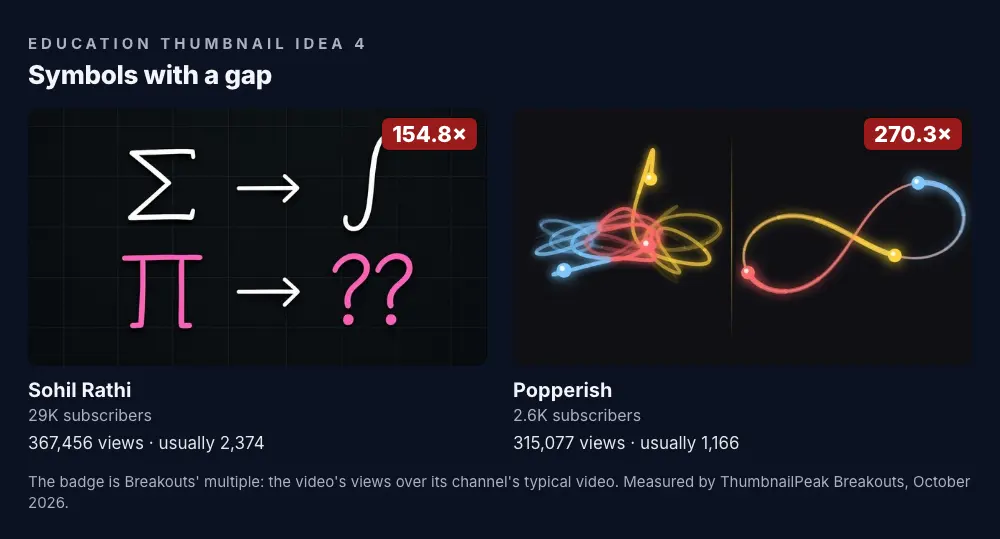
Sohil Rathi's thumbnail asks a maths question with no words. Σ, a sum, becomes ∫, an integral. So what does Π, a product, become? "??". Anyone who has done calculus gets the question in a second, and wants the answer.
Popperish's "Three-Body Chaos Hides A Perfect Figure-Eight" does it with a picture. On the left, three bodies' orbits in a glowing tangle. On the right, the same three tracing a perfect figure-eight. It got 315,077 views, 270 times the channel's usual.
Both thumbnails have a gap: the missing operation, the hidden order. The video fills it.
How to use it: for maths and science, show the pattern the viewer knows and leave a visible hole where the new idea goes, a "??" or a before-and-after. Don't explain it on the thumbnail.
5. Draw it simply
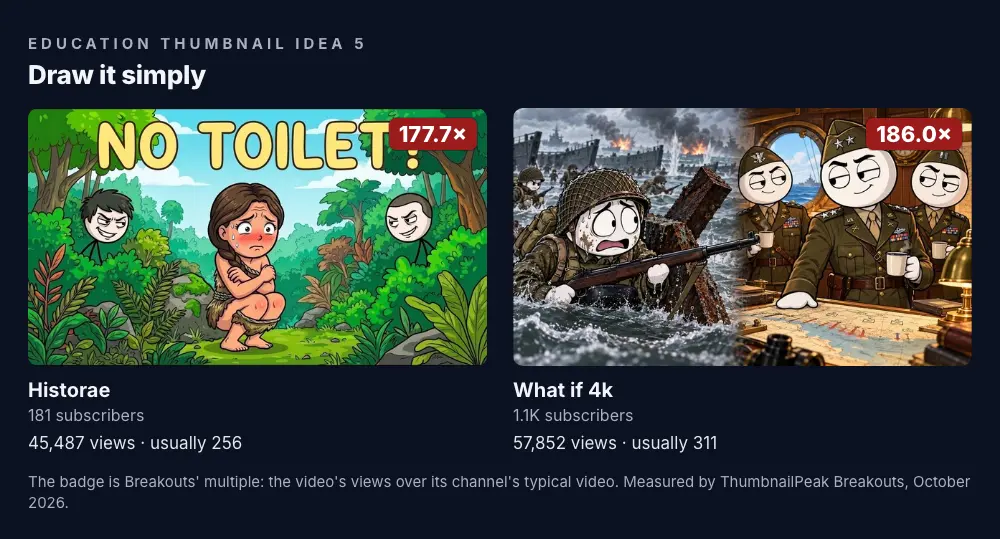
Both of these are small history channels that draw their videos, and their thumbnails show why the style works. Historae's "How Did Humans Actually Invent the Toilet?" asks "NO TOILET?" over a cavewoman with a problem and two neighbours grinning from the bushes. The channel had 181 subscribers. The video got 45,487 views.
What if 4k's "Your Life as Every Rank in the U.S. Army in WW2 (POV History)" puts the whole idea in a split: a terrified private wading ashore on one side, three generals with coffee cups on the other. Rank, in one picture.
A drawing can show a feeling, an absurd situation or a contrast that no archive photo has.
How to use it: if your video is animated, use your own style on the thumbnail, with one exaggerated expression and one idea. If it isn't, a simple drawing can still explain a concept better than a stock photo, as long as the video delivers what it shows.
6. One calm sentence
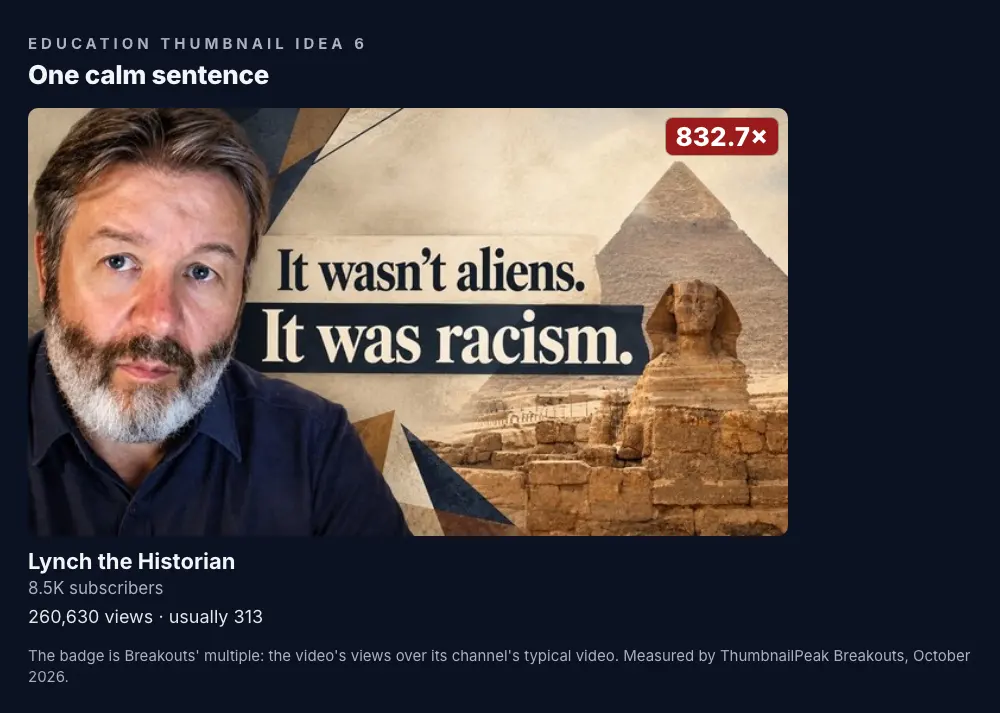
Lynch the Historian's "The Racist Origins of Ancient‑Civilisation Myths" got 260,630 views on a channel that usually gets about 310: 833 times its usual, the biggest multiple on this list. The thumbnail is his face, a pyramid, and two short sentences in a plain serif font: "It wasn't aliens. It was racism."
It doesn't shout. No capitals, no colours, no arrows. Among thumbnails that all shout, a calm, confident sentence stands out, and the claim is strong enough on its own.
How to use it: if your video argues a clear point, write it as one or two short sentences, in normal case, and let it sit next to your face. Make sure the video backs the claim up. A calm thumbnail that turns out to be wrong loses trust fast.
7. A number about one person
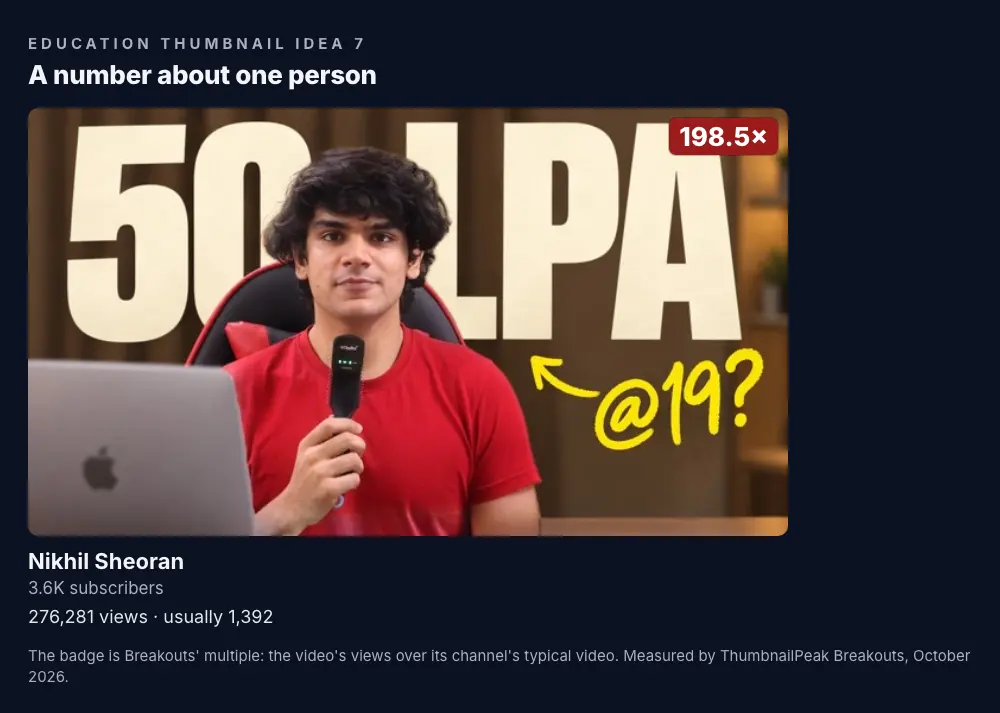
Nikhil Sheoran's "How I got a 50 LPA remote job at 19 (storytime)" got 276,281 views, 199 times his usual. "50 LPA" means 50 lakh rupees a year, a very big salary in India, and his audience knows it. The thumbnail puts that number behind him in huge letters, and adds "@19?" in his own handwriting, with an arrow pointing at him.
The number is impressive. The age makes it personal and hard to believe. The question mark invites you to find out how.
How to use it: for career, money and study stories, put the result in the units your audience uses, big, and add the one detail that makes it surprising, like an age or a timeframe.
What a thumbnail can't do
None of these thumbnails made its video break out on its own. Comparing 3,523 channels' breakouts with the same channels' ordinary videos, we found they looked the same: the same number of words, the same faces, the same colours. The details are in what a thumbnail can and can't do.
What set these videos apart was a question people wanted answered: what does a product become in calculus, why was ketchup medicine, who really built the pyramids. The thumbnail asks that question in a second. And for educational channels, delivering the answer matters more than anywhere else. A thumbnail that promises something the video doesn't explain is clickbait, and viewers who came to learn leave fast.
Borrow the idea and the structure. Don't copy the image, since a copy competes with the original for the same click.
Find this month's education breakouts
Open the Categories tab on Breakouts and pick Education. It's free and needs no account. Each category is swept once a week and keeps about a month of videos, biggest breakout first.
Education is a broad label, so expect children's songs, finance and how-to videos next to history and science. The filters narrow it: your channel size, 10×+, the last 30 days, and the Language filter for titles you can read. For one subject, like "Roman history" or "linear algebra", the Search tab measures YouTube's top results for it. That needs a free account, which comes with 12 credits; a search uses 1.
Each card's Critique this thumbnail button sends it for an AI critique, which explains what's working. When yours is ready, put it in a real YouTube feed with the free thumbnail tester to see it next to the videos it will compete with.
Key takeaways
- Ask the question the video answers. Education breakouts asked questions more than any other category we read.
- Show the gap. Σ → ∫, Π → ??. A missing piece is a reason to watch.
- Draw the contrast. Two versions of one person, a poison bottle and a ketchup bottle.
- A calm sentence can stand out. "It wasn't aliens. It was racism." in plain type, among thumbnails that shout.
- Borrow the idea, not the image.
How we picked these: the videos come from the Education grid in ThumbnailPeak's Breakouts on 22 October 2026, published 5 to 19 October. Each video's "usual" is the median views of its channel's 10 most recent uploads that were at least two weeks old, or as many as a young channel has, down to three, and the badge is its views divided by that. We read the 60 biggest breakouts with at least 30,000 views, one per channel, and checked each example against the three frames YouTube saves from the video. Faces and headline words were counted with Apple's Vision framework on our own computer, as in our posts on faces and text. View counts are Breakouts' measurement on 21 October 2026 and keep changing. Thumbnails and channel names belong to their creators and are shown for commentary and education.