Disclosure: we make ThumbnailPeak, which has its own AI thumbnail generator, and these videos come from its free Breakouts tool. The thumbnails belong to their creators, who had nothing to do with this post, and are shown here for commentary. Every number below is from thumbnails read on 1 November 2026.
Do AI thumbnails work? We can't tell you how many people clicked a thumbnail: YouTube only shows that to the channel. What we can count is how often AI-made thumbnails show up on videos that did unusually well. So we took 4,297 breakout videos from October, one per channel, and looked at every thumbnail. Here's what we found:
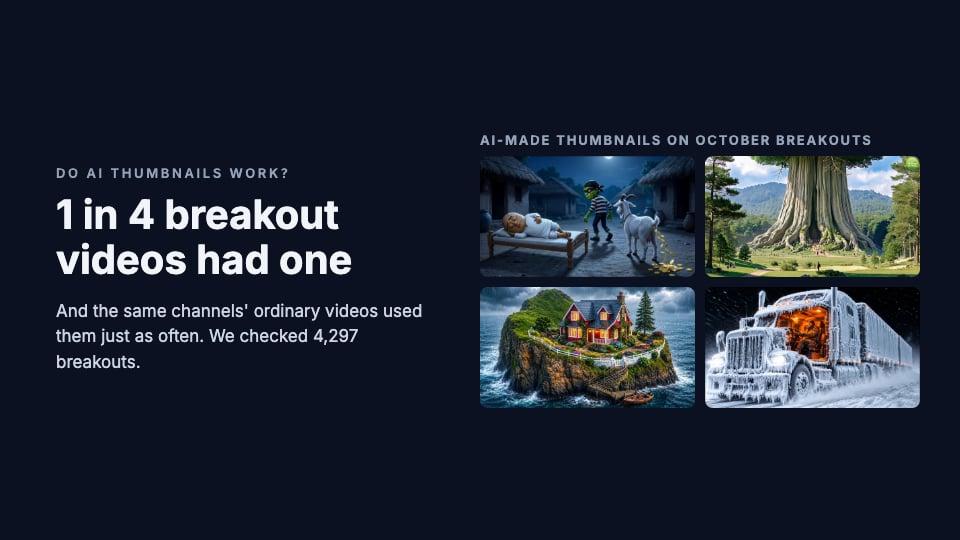
- About 1 in 4 breakouts (25%) had a thumbnail that looked AI-made. About 1 in 25 (4%) were unmistakable.
- It depends on the kind of video. 38% in Film & Animation and 34% in Education, but 12% in Comedy and 10% in Sports.
- AI didn't make the breakout. The same channels' ordinary videos had AI-looking thumbnails just as often: 24%, against 25% for the breakouts.
- A breakout looks like its channel. Where all four of a channel's ordinary videos had AI-looking thumbnails, 82% of breakouts did too. Where none did, 8%.
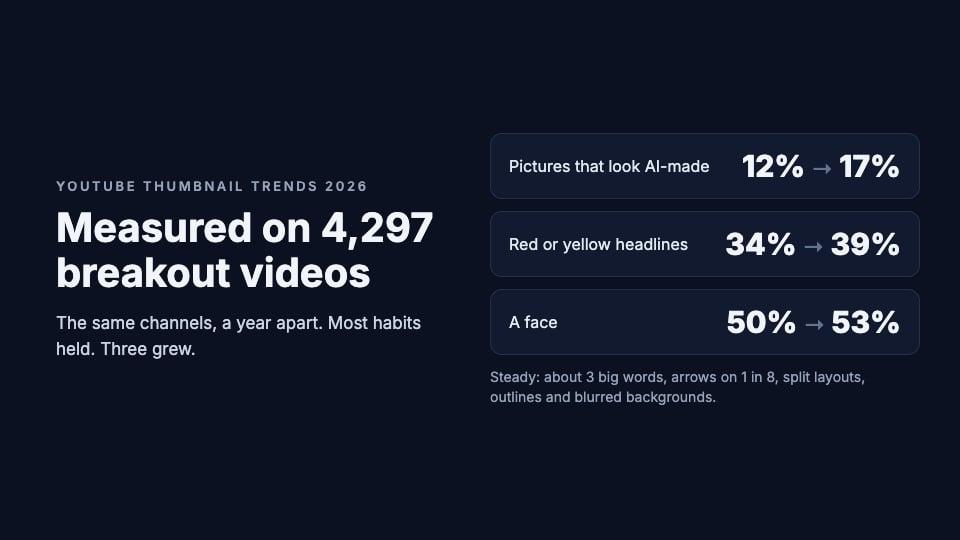
- They're spreading. For the same 883 channels, AI-looking thumbnails went from 12% a year ago to 17% now.
How we counted
ThumbnailPeak's Breakouts sweeps YouTube every week for videos that got far more views than their channel usually gets. On 1 November 2026 we took every channel whose best video from 2 to 29 October had at least three times its usual views. That gave 4,297 breakouts in 12 YouTube categories. For 4,275 of those channels we also took their four newest ordinary videos, ones that got between half and one and a half times the channel's usual views, to compare.
Then an AI model labelled every thumbnail against a written rule. A thumbnail "looks AI-made" when its main picture shows the marks of an image generator:
- A scene that couldn't have been photographed, finished unusually smooth, glossy and evenly lit.
- Skin like wax or plastic, or faces that are too perfect or slightly wrong.
- Broken details: hands, teeth, eyes or objects that melt into each other or don't make sense.
- Garbled letters or signs inside the picture (the headline the creator added doesn't count).
- The generator "digital art" look: dramatic rim light, haze, everything hyper-detailed and saturated.
A real photo or video frame doesn't count, even when it's cut out, outlined, colour-graded or put on a new background. Nor do game screenshots, hand-drawn cartoons or a game's own 3D graphics.
The model answered "clearly AI", "likely AI" or "not AI". We count the first two as "looked AI-made". To check it, we ran a second pass on 300 random breakouts: the two agreed on 90% of them, and both put the share at 25–26%. We also looked at samples by eye. Of 30 thumbnails labelled AI, 3 were clearly wrong: a game's official art, a product render and a creator's real photo. Of 40 labelled not AI, 2 to 4 might have been. The mistakes run both ways, so the overall share holds up, but any single category's number could be a few points off.
About 1 in 4 breakouts had an AI-looking thumbnail
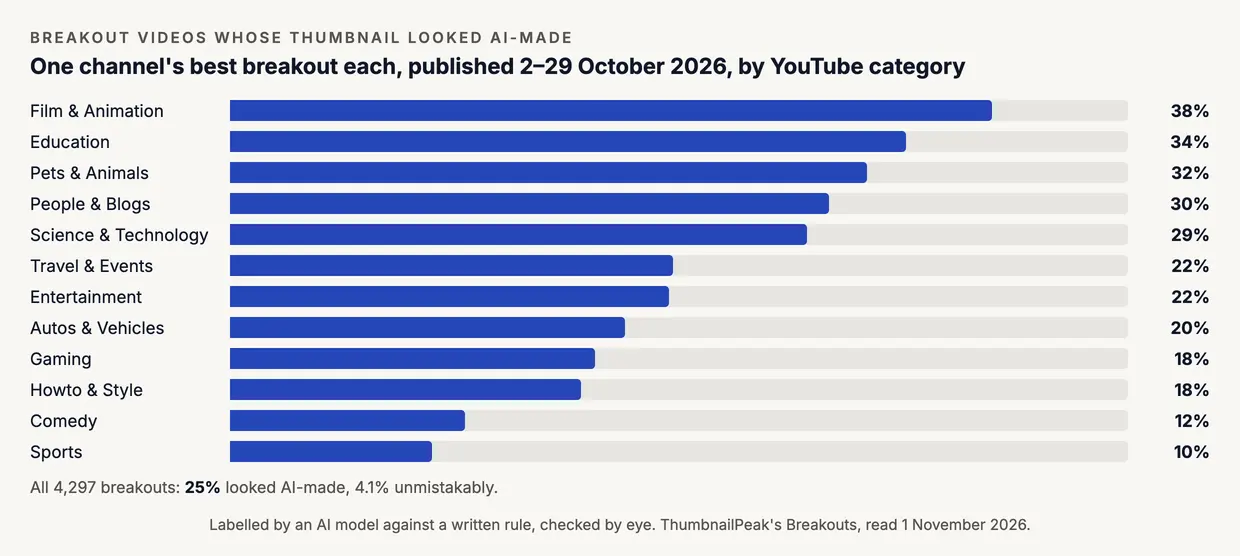
Across all 4,297, 25% looked AI-made. The highest shares were in the categories where a picture has to show something no camera filmed: animated stories in Film & Animation, history and science explainers in Education, imagined wildlife scenes in Pets & Animals. The lowest were Comedy and Sports, where the thumbnail is usually a real person or a real moment.
Here are six that broke out in October with thumbnails our rule calls clearly AI-made:
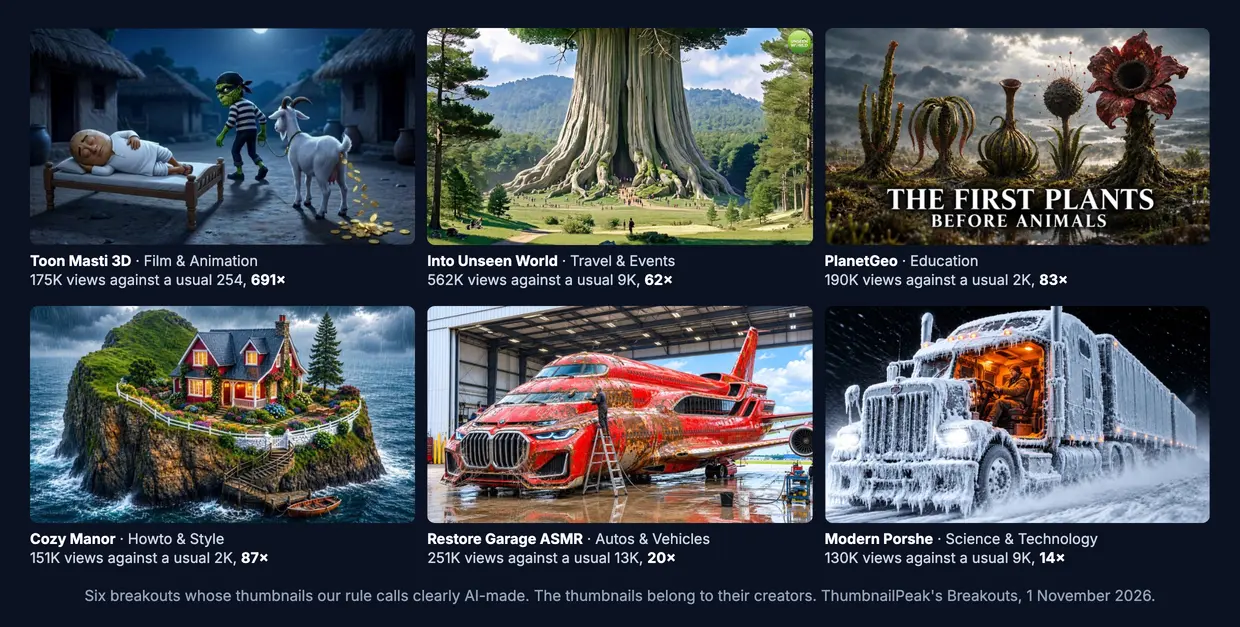
Most of these channels usually get a few hundred or a few thousand views. That matters for the next part.
The breakout didn't need the AI picture
If AI thumbnails made videos break out, breakouts would use them more than the same channel's ordinary videos. They didn't, by much. Across 4,275 channels, 25% of breakouts had an AI-looking thumbnail and 24% of the ordinary videos did. The gap is 1 point, and it could be anywhere from 0 to 2.
What predicted a breakout's thumbnail was the channel:
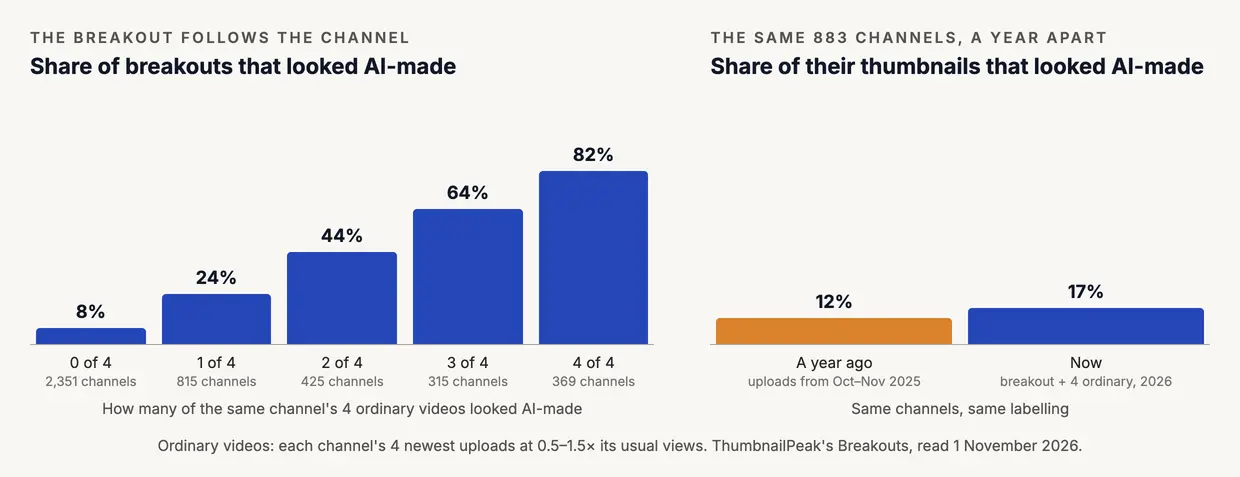
Channels that make AI thumbnails broke out with AI thumbnails, and channels that use real photos broke out with real photos. That's the same thing our study of 17,609 thumbnails found in October for words, faces and colours: a breakout's thumbnail looks like its channel's ordinary ones. Whatever made those videos take off, it wasn't switching to an AI picture.
Do AI thumbnails get fewer views?
We can't answer this one straight, and we'd be wary of anyone who says they can. Here's what the numbers do show.
Channels whose thumbnails all looked AI-made, at least four of the five we read, are smaller. Their usual video got about 8,800 views, against about 14,400 for channels with no AI-looking thumbnails, and they had about 15,000 subscribers against 70,000 (medians). But their breakouts were bigger jumps: about 13 times their usual views, against 7 times. A small channel's hit is a bigger multiple of a small number.
That doesn't mean AI thumbnails cost views. These channels are smaller for many reasons: many are new, and many make a lot of videos quickly. What it does mean is that "AI thumbnails get fewer views" and "AI thumbnails get more views" both need the same channel, the same kind of video and the click numbers only the channel can see.
If you want to know for your channel, test it on your channel. YouTube's own Test & Compare shows two or three thumbnails to different viewers. Our A/B testing guide explains how to read what it tells you.
Why do AI thumbnails look the same?
Because most of them are made the same way. Of the breakout thumbnails that looked AI-made:
- 97% had the generator "digital art" look: rim light, haze, everything sharp and saturated.
- 84% were entirely generated, rather than a real photo with an AI background (8%) or a few AI elements (9%).
- 29% showed a scene that couldn't have been photographed.
- They were more saturated. The median saturation was 0.44, against 0.38 for the other breakouts: about 14% more.
- Fewer had a face: 47% against 51%.
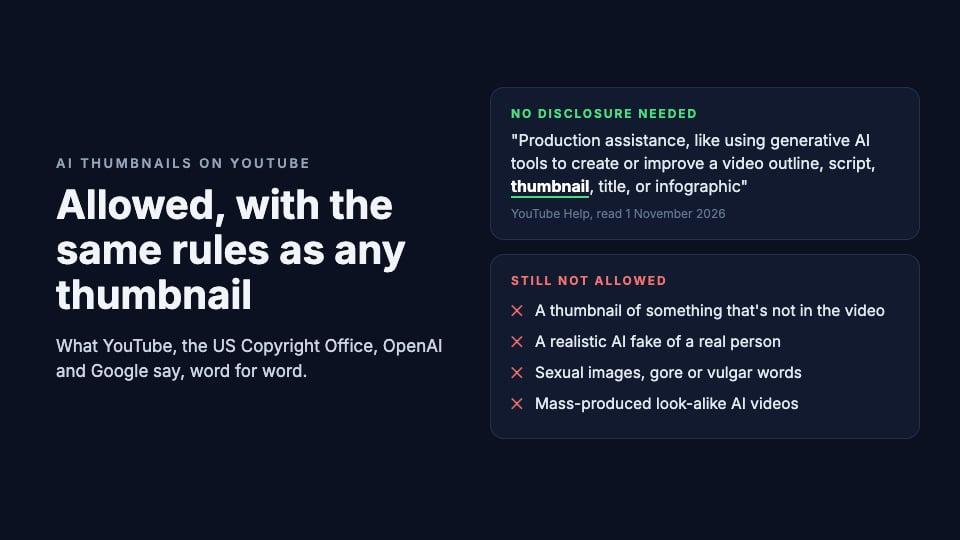
That shared look is fine for a channel whose whole style is illustrated stories. It's a problem when your thumbnail sits in a feed of thirty others made with the same tools, and when the picture shows something your video doesn't. Our post on whether AI thumbnails are allowed covers YouTube's rule on thumbnails that mislead.
Do people hate AI thumbnails?
We can't measure what viewers feel, and we won't guess. Two things we can say: viewers clicked these thumbnails enough to make their videos breakouts, and channels are using them more each year. For the 883 channels we could compare with a year earlier, 199 had no AI-looking thumbnails in October 2025 and at least one now; 59 went the other way.
What this means for your thumbnails
- An AI picture isn't a shortcut to a breakout. Breakouts looked like their channel's usual thumbnails. If your channel uses real photos, the videos that break out will probably use them too.
- Use AI on your real subject. The AI thumbnails that work for explainers and stories show the video's actual idea. Attach frames or photos and describe what's really there; our prompt guide shows what that changes.
- Watch the shared look. Saturated digital art is everywhere. A real face, a real object or your own style is easier to tell apart.
- Keep it honest. Don't draw what the video doesn't show.
- Check before you switch. Preview it in a YouTube feed beside the videos it'll compete with, and test it against your current style.
ThumbnailPeak's AI thumbnail generator starts from your video's link and draws from its frames, so the picture shows what's in the video. It needs a free account, which comes with 12 credits; one thumbnail uses 3. And Breakouts is free to browse by category, if you want to see what's breaking out in yours this week.
Key takeaways
- 1 in 4 October breakouts had an AI-looking thumbnail, from 10% in Sports to 38% in Film & Animation.
- Breakouts used AI thumbnails as often as the same channels' ordinary videos: 25% against 24%.
- A breakout looks like its channel: 82% AI-looking where the channel's ordinary videos all were, 8% where none were.
- AI thumbnails are spreading: 12% to 17% in a year, for the same 883 channels.
- Nobody outside a channel can see its clicks. Test AI thumbnails on your own channel before you switch.
Breakouts: each channel's best video published 2–29 October 2026 with at least 3× its usual views (usual views are the median of the channel's recent eligible uploads), from ThumbnailPeak's weekly Breakouts sweep, read 1 November 2026: 4,297 channels in 12 YouTube categories. Ordinary videos: the channel's four newest uploads at 0.5–1.5× its usual views, at least 14 days old (4,275 channels with all four read). A year ago: for 1,500 of those channels chosen at random (125 per category), up to four long-form uploads published 1 October–15 November 2025, closest to 31 October; 883 channels had at least one. Thumbnails were read from YouTube at 640×360 and labelled by gpt-6-luna (low effort) against the rule above; a second pass on 300 random breakouts agreed on 90%. The range on the 1-point gap is a 95% bootstrap interval across channels. View and subscriber counts are YouTube's, as Breakouts last measured them. The raw rows are not kept, under YouTube's 30-day storage rule; only these totals are.